Every so often, I remember how fun it is to participate in a print exchange. This year, I choose to participate in the Emerald Print Exchange. The wonderful thing about print exchanges is that the thrill and benefits last long after the exchange ends because you are the recipient of a packet of wonderful prints from who knows where/who.
With this project, I decided to continue my minimalism trend of artmaking as a subject for the exchange. I choose one of the drawings I have been making of a person and their shadow/guardian. At some point, I will show these drawings on this blog but for now I am just going to focus on the drawing I choose which is probably the most minimal of all the drawings. To give a sense of scale, the drawing is in a pocket size notebook so the paper is about 3″ x 4″. It is just done with a black gel pen.

Now the interesting thing about this drawing is that is could actually go either way. This is the actual way I drew it but as a nod to the notion of the image’s flexibility, I decided to call the piece Either Or and sign the resulting print in a way where the viewer can decide.
Wanting to experience the full range of choices in printmaking, right from the start I made both a woodblock cut and a dry point/aquatint engraving. Below are the two different plates.

Yesterday the fun really kicked in when I did proofing of both plates. I soon realized that the woodblock would be the better choice for the exchange because it will be less problematic to get consistency with each print pulled. I will explain more of this later in this article. Below are both the results in woodblock (left) and the dry point (right). You can right click on either image to open a larger version.
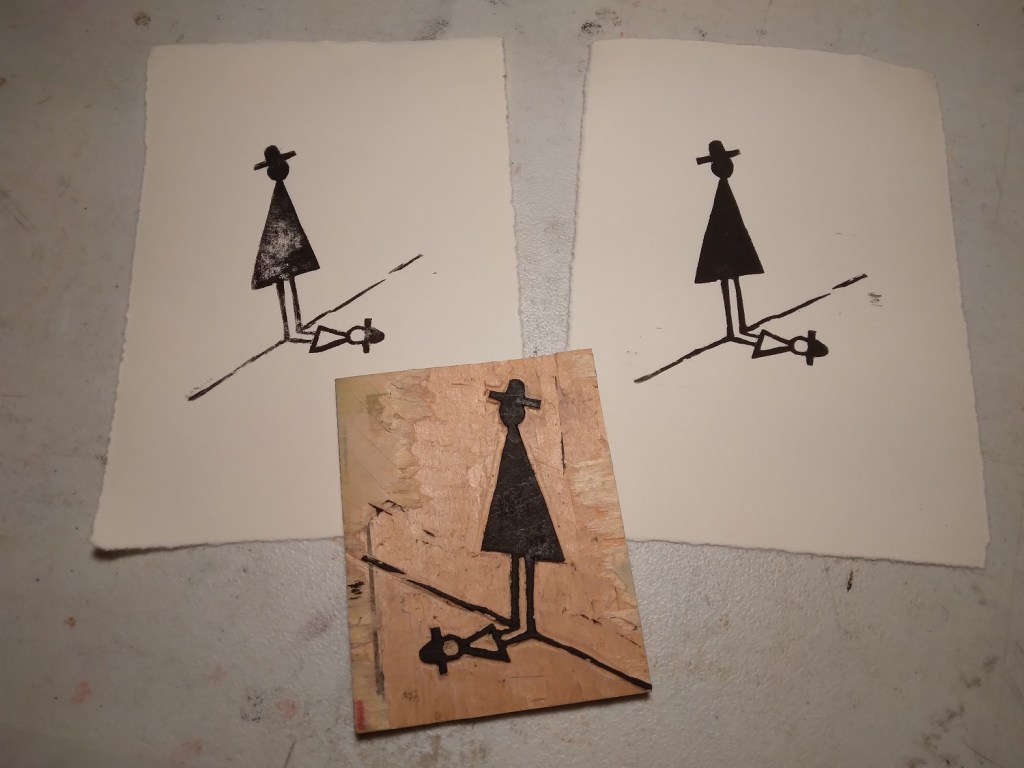
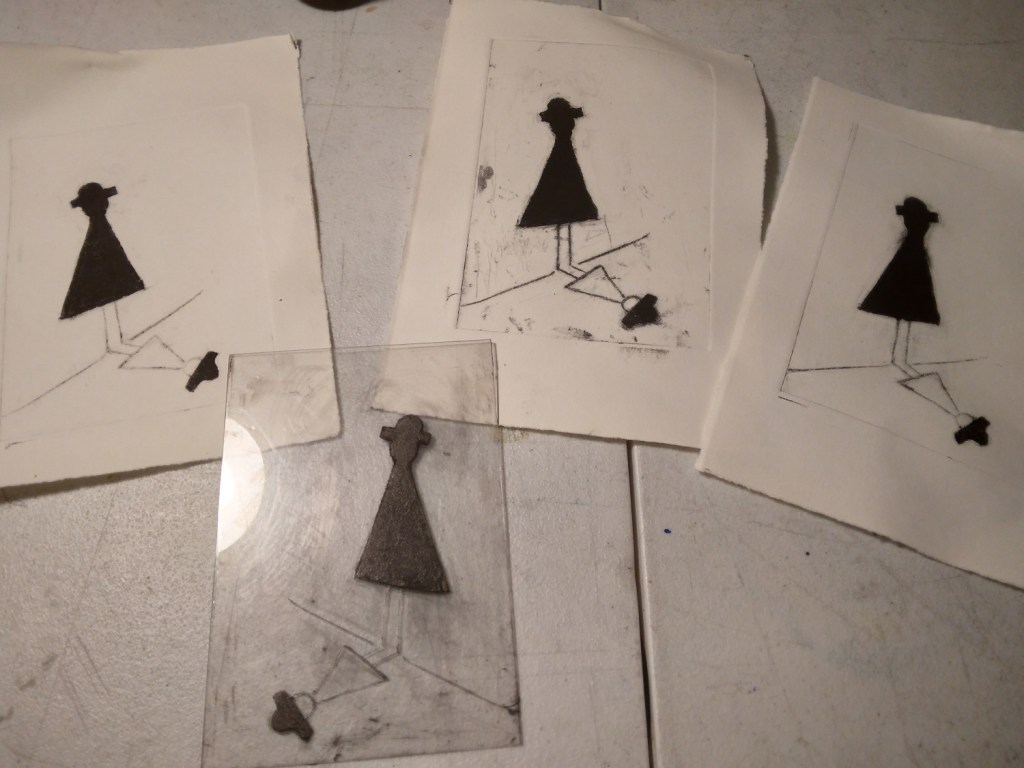
So the reason the woodblock will be easier to print consistently is because the application of ink is more straightforward – the ink is just rolled on the raised surface and the carved image (barring some sort of odd accident) will retain its original form. For the dry point, the ink is applied then wiped away leaving the ink in the recessed areas. The problem with getting consistency with the dry point is the plate on which the image is made. Traditionally, zinc or copper is used and this is a plastic plate.
With dry point, there is no acid involved. Therefore it is an engraving technique, not an etching technique. The beauty of the dry point is the soft velvety line left from what is called a ‘burr’. In engraving, the tools are made to cut away the burr leaving very fine even lines. With dry point, the tools do not cut away that cleanly so a small bit of metal (the burr) remains on the plate and catches ink. Copper or zinc plates keep their burr for a fairly long time. With the plastic plate, the weight from the press smashes the burr rather quickly so you have to keep going back into the plate and scribing again. This will eventually lead to a very different looking image over the course of times the plate is printed.
Now that I made the decision to use the woodblock, I have to decide if I want to carve another block for a background. I will publish those experiments as I do them. Thanks for printing with me today!
 anniepodart.com
I like where you’re going with this. I’m interested to see how you treat the background.
LikeLiked by 1 person
Thanks Claudia. I will update you in my next email.
LikeLike