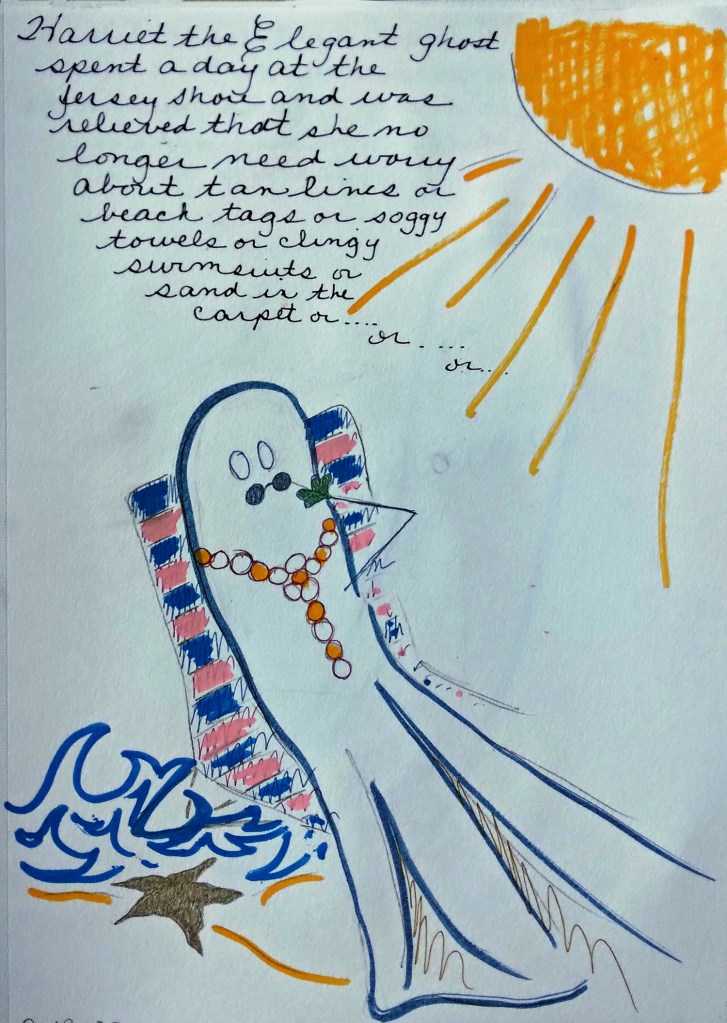
Harriet Goes to the Beach

There is a number of years between my oldest sister, Karen, and myself. In fact, I don’t even remember her living with us much other than here and there between different life events. She tended to move around a lot and travel a lot which most people, and I guess particularly women, did not do in the 1960s and early 1970s. What I do remember is that she was my barometer for what it meant to be grown up when I was a little kid. On reflecting now, at age 63, I probably should have held onto that particular idea.
During one of the times that Karen was back ‘home’, I recall several evenings when I would get out of bed to use the bathroom and see the light still on downstairs. It was probably only around midnight but everyone else was asleep and it seemed extremely late to me. I would peek down the steps and see Karen sitting in this black recliner she brought home with her, staring out the window smoking and drinking scotch. At one point I was so curious I ventured downstairs to ask what she was doing and she said ‘Just thinking’. Wow! I figured this must be what it was like to be a grown up; count me in!
There were other things Karen did that seemed worldly to me. She had a skin care regime that included odd products like astringent, read Cosmopolitan magazine (which I would sneak and read), and ate something called Bagels. Whenever she went to a movie, I always asked her what it was rated (the rating system being new at the time). One time, she went to see a new movie called Midnight Cowboy. When she told me it was rated X, I was shocked!
Karen worked as a journalist most of her life. One morning before I went to school, I asked her to write a note for me in case I had to go to the bathroom. I had a teacher in 5th grade who said he would not let anyone go to the bathroom without a note from home. Being 10, I took him very seriously. She wrote me a note and then when I repeated the request the next day, she decided she would furnish me with several days worth of notes courtesy of the staff at the Philadelphia Daily News. Thereafter, notes were no longer required
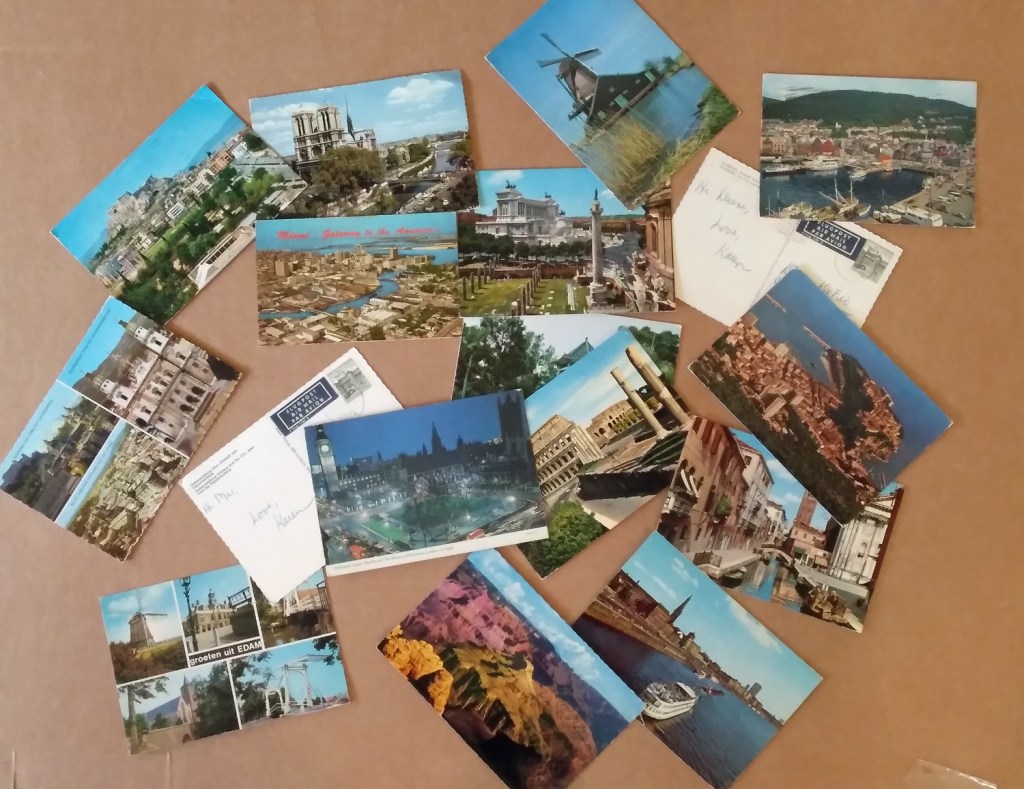
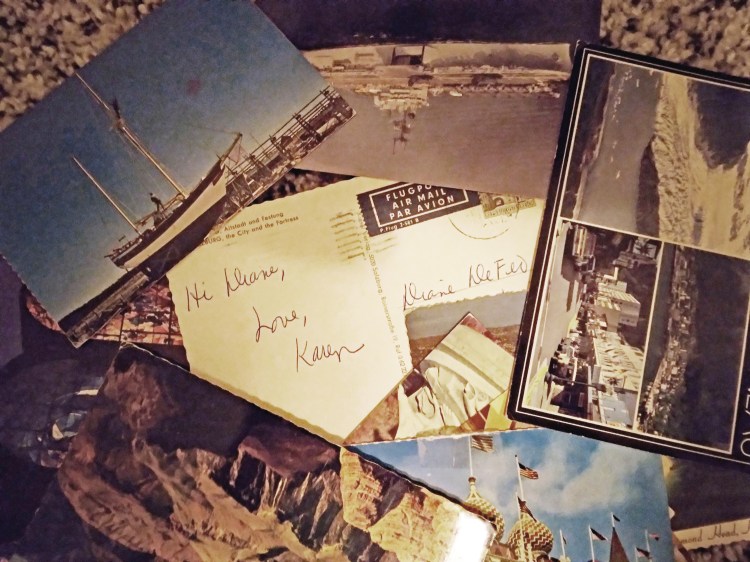
So back to the title of this blog post Love, Karen. Karen traveled very often and sent postcards regularly, not only to the whole family, but to each of us individually if she saw a card that she thought we would like. Two of the notes on these postcards I thought were particularly funny:
From the Grand Canyon in 1971: I’m sitting at [the] Grand Canyon on lookout point – grooving along with nature. Love, Karen This sentiment could only have been written and sent during that time period.
From Monaco, circa 1976: Stopped by to see Grace & Rainier but they weren’t around Love, Karen
Often, they said nothing more than Hi, Love Karen

As I have written about in the past, I currently work in an herbarium. For a very long time, I mounted botanical specimens. Now we are pretty caught up on that and I am delving into other tasks that surround collections. One of the things I work on fairly regularly is looking up current taxonomy. I used to not only desire to know about plants, but also know several of their names, both common and Latin. I have come to realize that this is a futile task.
First of all, common names are largely based on culture and geography. I learned this immediately when my friend and now coworker Stefanie was calling a tree a Tamarack and I was calling it a Larch. We were talking about the same tree. This is why people do use Latin names. However, after working in the herbarium I have come to realize two facts: (1) There are millions of plants and I will never know even a fraction of a fraction of their names and (2) Latin names also change, and much more often than you would think. This is why I have to check for taxonomy updates. Plants that have been collected even just a few years ago, may have a new Latin name assigned and can even be assigned to a new family. There can even be a new family! According to Jim, the botanist, there are two kinds of botanists: lumpers and splitters. Which is what brings me to the photographs in this post.
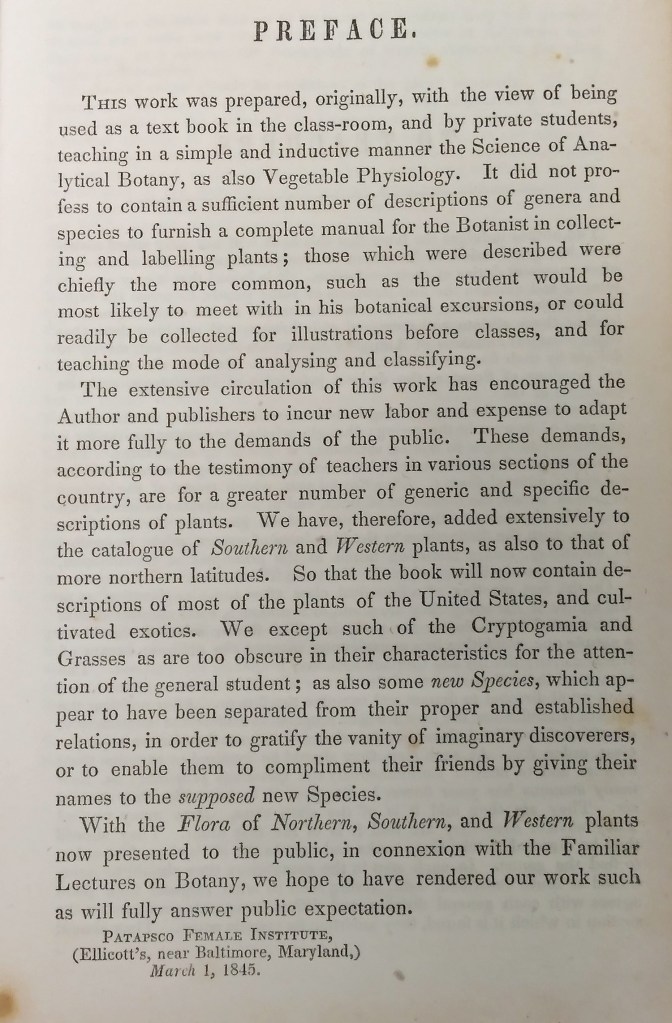
I came across this book on one of the herbarium shelves, and, being very attracted to the binding and typeface, picked it up immediately. The image at the top shows the title page Lectures on Botany, by Mrs. Lincoln (as written on the spine of the book). Mrs. Lincoln was the principal at the Patapsco Female Institute of Maryland and author of books on natural history. I decided to read the preface of the book where she discusses, among other things, what she choose to exclude from this text. I almost fell over laughing at the part I have underlined in red below where she writes :

While changes that occur in recent years do rely on DNA of plants to really tell if there is a new species or not, you cannot overlook the vanity of what drove people to make such ‘discoveries’ in the past. And possibly the fame of discovering something new still drives people, which is not necessarily a bad thing all in all.
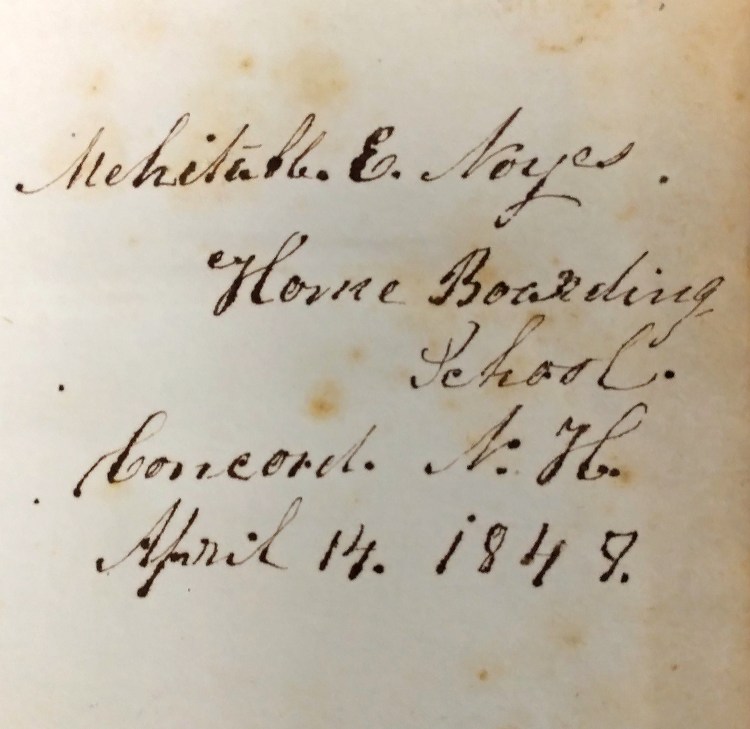
But I cannot leave this post without sharing two other things. One is the beautifully written inscription inside the front of the book indicating to whom this particular volume belongs. The other is the entirety of Mrs. Lincoln’s Preface.
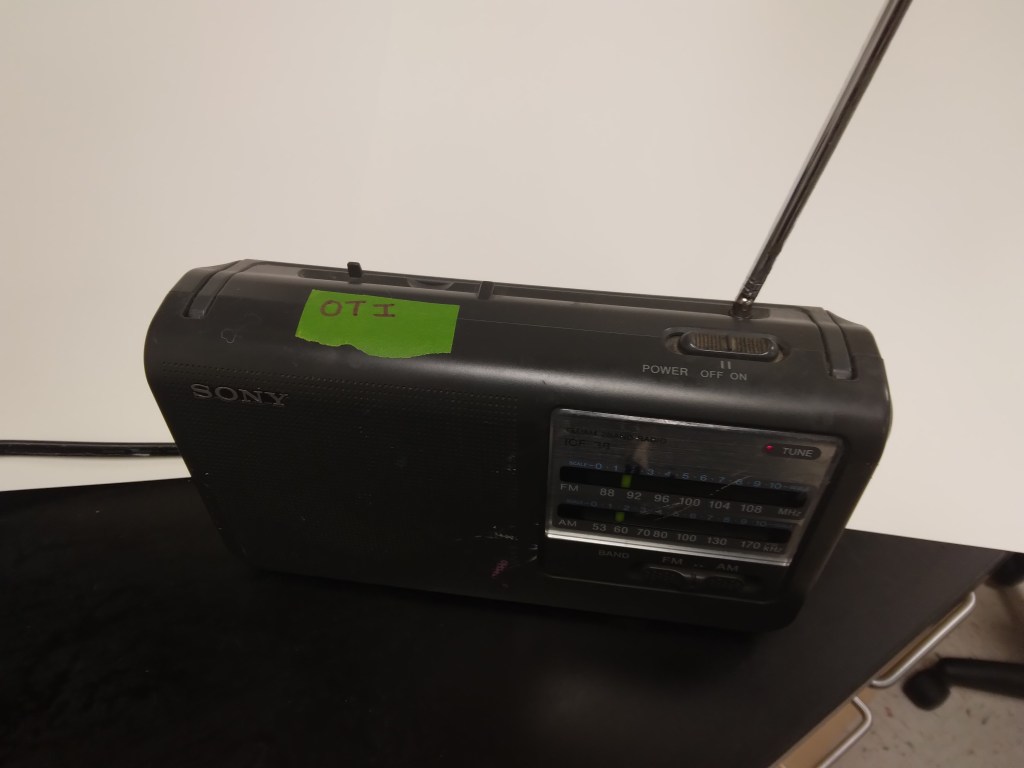
Earlier this summer I spent several weeks in Maryland. I packed lots of ‘comforts’ that I depend on at home. One of them was this.

I am a radio person, more so than a TV person. So when my grandson, age 4 1/2, saw my radio, he was very curious. I showed him how to turn it on, which he did about five thousand times. Then he said “Grandmom, tell it to play [a specific song]” I explained to him that the radio played what the person at the radio station wanted, not what we wanted. He decided that this odd piece of technology was worth taking to school for show and tell, which he did. Apparently, his school friends were equally amused by this contraption.
The particular radio I took was the one I keep at work (though I have another just like it at home as well as two other models). Anyway, when I brought it back to work, I noticed the green name tag we put on it when he took it to school was still there. I decided to keep it there!
A few posts ago I shared a sketch I made of my mom from a memory I have of her. So it did not surprise me that lately I have been thinking about particular memories of my dad. What I decided on was a sketch of my dad shopping. As with the sketch of my mom, this is not meant to be a realistic depiction but more of the essence of a particular memory I have.
In order to grasp this image, there are a few things I need to explain about my father. First of all, he loved to shop and really, Really, REALLY loved bargains such as: 50 pounds of sharp provolone cheese, 6 foot in diameter rolls of paper towels, cigarettes he got cheap and gave to people as he lectured them about smoking, etc. But what really stands out about my dad’s shopping habits at this moment is not so much what he bought but how he walked around the store.
My dad was an average size man but he had a very strange shape from the back view. He was straight up and down and had absolutely no rear end. Therefore, his pants were always baggy in the butt. They stayed up by assistance of a belt and a very large belly that was solid muscle (which was not at all apparent from the back). He also had excessively long arms which contribute to this particular memory of him. As dad walked around looking for bargains we had no use for, he would hold his hands behind him in a very contorted manner and point his fingers upward. Usually one hand he held his fingers splayed apart and the other hand his fingers were together as if he was cupping something in that hand. Observing these mannerisms resulted in hysterical fits of laughter from my mother and I. In addition, he was always humming. The song that comes to my mind is one that was a favorite of his is The Shadow of Your Smile.
What struck me odd when I made this image was that I could not really picture any of my father’s clothes. I could picture him in his fireman’s uniform and his painting job clothes (fireman always had about a thousand jobs because they generally had large families, low pay, and a schedule that allowed them to hold down other jobs). He was not by any means a flashy dresser barring the occasional Hawaiian shirt popular in the 1960s and 1970s. His shirts were generally pale in color; that much I remember because they contrasted his olive complexion. I have very vivid recollections of my mother’s clothes but not so much my father‘s clothes which is strange since he was my main caretaker.
So below I present my memory of my dad, hands awkwardly positioned behind him, as he wanders through one of the many stores he loved – Sears, Two Guys, the PX – surrounded by the glitz and glamour of bargains he could not resist.

I spend a lot of time in the Baltimore area and recently I heard some commentary on WYPR (NPR Baltimore) regarding telephone culture of the past. My ears perked up because this was something I wrote about on my last Local Post which you can find here. The commentator talked about telephone exchanges in Baltimore and how they also were an indicator of a person’s social status since the exchanges was based on the neighborhood you lived in or worked.
So playing off of social status, the next thought that wanders into my mind are names, which are another indicator of local culture. Belk is a well known name where I currently live in North Carolina that is associated with a local department store. Van Every (Lance Crackers – Yum!) is another name of note here in North Carolina. Every city, town, and small borough has it’s local famous families. In the Pittsburgh area, those people were the Carnegies and Mellons. Girard is a Philadelphia family as is Rittenhouse. Often these people started in industry and then entered politics directly or had great influence on politicians. Many became great philanthropist but also were quite despicable! What are some of the famous local names where you live? What are those people known for?
Recently I heard from my friend Allison Wooley, who I met during a residency I did through through the Philadelphia Museum of Art’s Art Futures Program. Allison has since moved to Cleveland and sent me images of a public art project she is part of.
Allison has had two works accepted for public display through the Shaker Arts Council. These are electrical utility boxes that are wrapped with an image designed by a local artist. The images are printed on a plastic material and are permanently adhered to the utility boxes.
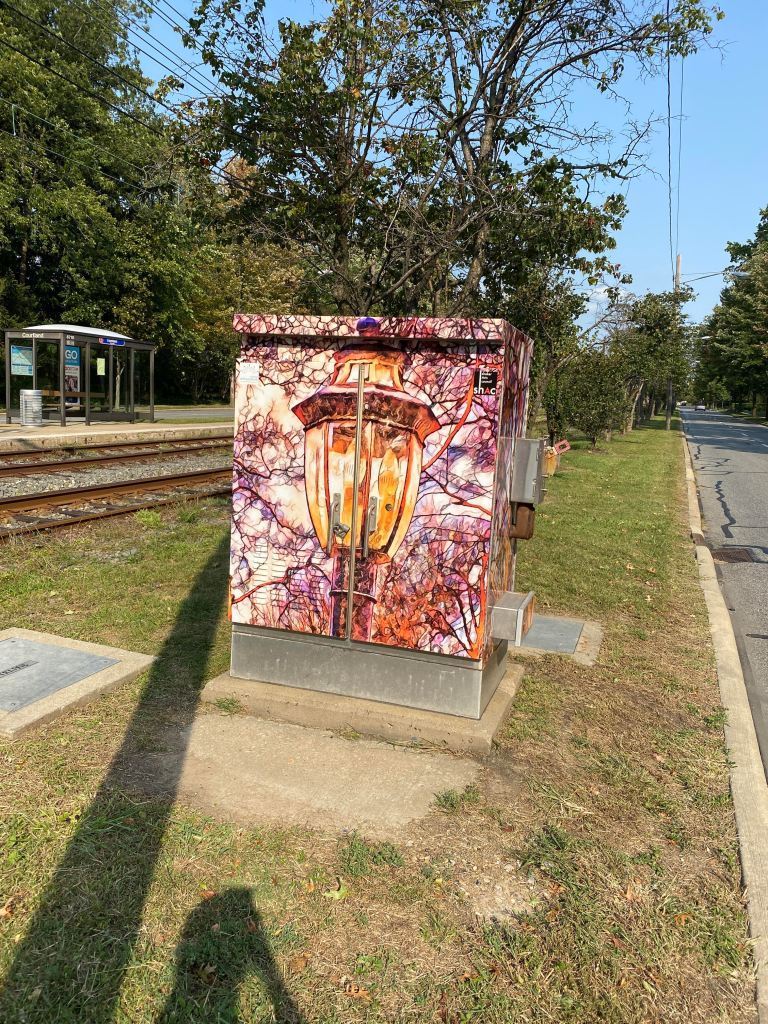
I was first reminded of the various similar project that sprang up several years ago in the Philadelphia area – the RCA dogs in Moorestown, cows and dinosaurs somewhere else. Those projects involved artists decorating a fabricated replica of whatever animal was being placed around the town. The animals had some significance to the area; the RCA dog related to the company being local to that area of New Jersey.
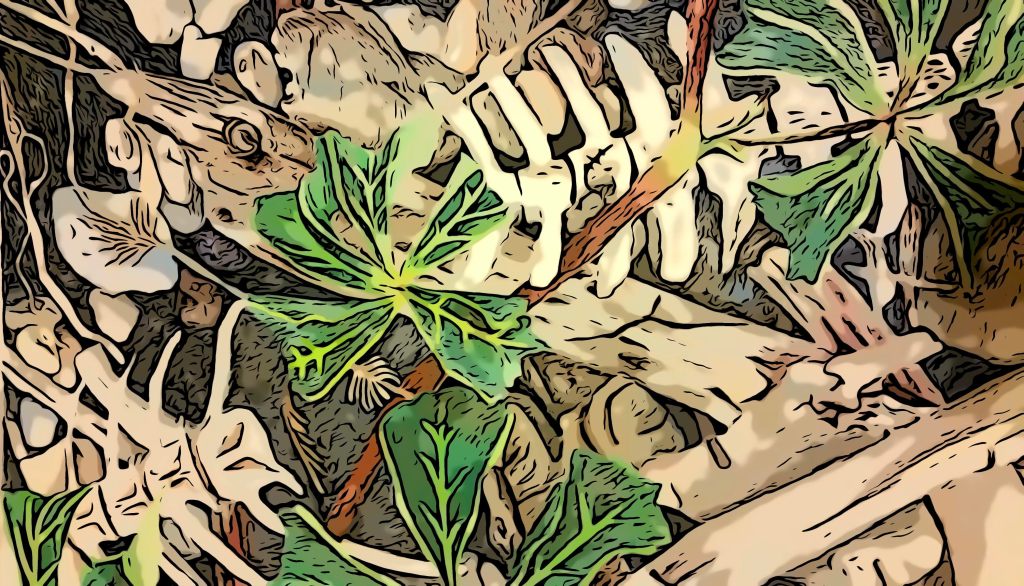
What I like about the project Allison is involved in is that it takes something that is part of our everyday infrastructure and modifies it so it is something pleasant to look at. As a person that does not like extra ‘stuff’, the utility of this project appeals to me (no pun intended). I had to ask, since Allison’s first design showed a street light, if the project had to be related to electricity but it does not. Her most recent one, that is currently being printed up, is of a fish bone she saw at Lake Erie.
You can see additional designs for the utility boxes here. Congrats to Allison!

 anniepodart.com