Karen Muldoon was born in Philadelphia, PA and currently resides in Hampton, VA
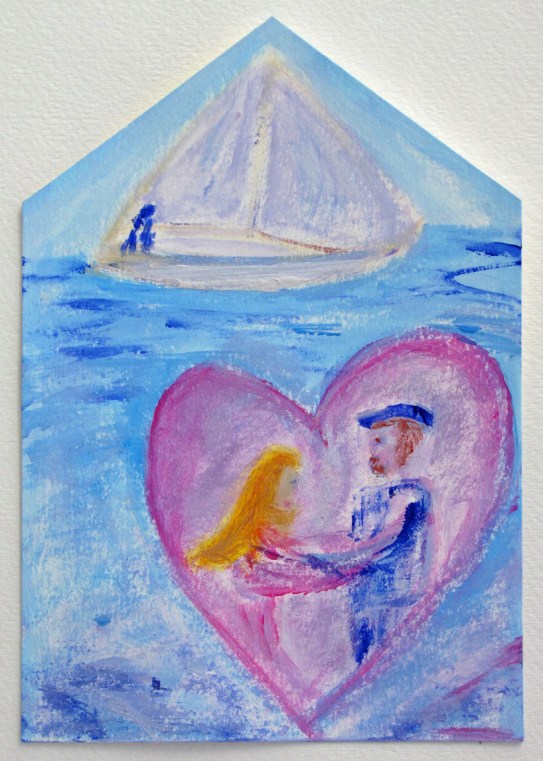
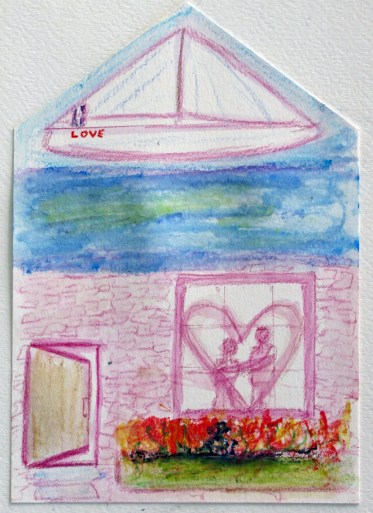
When I was young, home was always where my mother was. I took a long cross country trip in my 20s and when people asked me where home was I said “New Jersey” even though I had never lived there. My family had moved there while I was away. Later, when I married home was wherever my husband and I were together. We had a sailboat and sailed to many different places. Wherever we were together was home. So to me home is not so much a place as it is where I am with people I love. Hence, the sailboat and the couple in a heart.
Above the entrance of the now defunct Lit Brothers advertising a courtesy service. Photo by Carmen Martino
While there are chain departments stores that you can find in almost any city, there are those special local/regional ones that define an area. Where I am originally from, there were not only wonderful larger local department stores but some smaller ones as well. The larger department stores I am speaking of are Strawbridge & Clothier, John Wanamakers, and Lit Brothers. The smaller stores, and less well known are The Blum Store and Nan Duskins. If the names of any of these retailers are familiar to you then you are most likely from, or have spent a fair amount of time, in the Philadelphia area.
High above street level, this sign for the Blum Store with their elegant logo of a gloved lady’s hand holding a parasol, has weathered time.
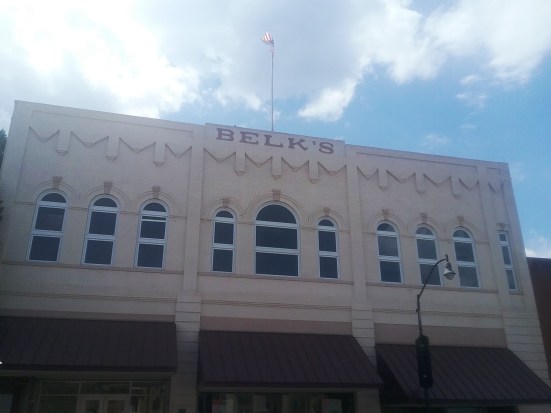
One of the older Belk’s locations somewhere in the Carolinas
Off and on we enjoy visiting Salisbury, NC, a small city/town approximately 40 miles from where we currently live. Salisbury is place rich in history and home to a wonderful main street and fabulous cultural facility called the Waterworks Visual Arts Center.
On a fairly recent visit, I heard two sounds that, not to be corny, resonated with me. Both sounds took me back years in time.
Salisbury, NC
The first sound was church bells. When I was a child growing up in Philadelphia, the church bells rang a few times a day and the melody that played around dinner time is especially memorable to me, not just because it meant “get home” but because it was a lovely tune. I have since learned most church bells are now generated via computer, often several states away from the actual church. Quasimodo would have to be retrained or find himself unemployed.
The second sound was something that I completely forgot about: people in a wedding party beeping their horns. I asked some people younger than myself if this is something they ever heard or heard of and it was not familiar to them. The main reason probably stems from the more recent tradition of holding the wedding and reception at the same location.
Another source of sound that, for me, conjures up feelings of familiarity and comfort is the radio. Where I grew up, there is a 24 hour news station on the radio. Their slogan is “you give us 22 minutes, we’ll give you the world”. Aside from their slogan and very catchy jingle, the sound that was always sort of comforting to me was this strange typewriter like sound that was a constant “taptaptaptap” in the background of the anchorperson’s voice. I am including a live link below (you may have to sit through a commercial) but if you listen to the actual newscaster, you will hear that sound in the background. KYW Newsradio link
Out of habit, and possibly a bit of nostalgia, the last time I was in that area, I put on KYW waiting for that “taptaptap” and the comfort it was to bring. Oddly, after two plus years away, I did not find it at all comforting but rather irritating. When tuning into other stations I had listened to, DJ’s voices that once were like family seemed strange. On my way home, when I approached an area where I was able to get my current stations and heard the voices that are now part of my everyday life, I found myself thinking “home at last”.
Although I knew this all along, my friend Claudia defines herself as a life long resident of suburbia. The profoundness of this did not strike me until I read the statement on the back cover of her latest collection of poems. How could I have been so blind as to the meaning of this? The majority of Claudia’s art, both written and often her visual art as well, are somehow intertwined with suburban living.
On the other hand, I have pretty much always been a city dweller. Maybe that is why Claudia’s world as a suburbanite was not apparent to me. I have also realized that not only do the landscapes of suburban, city, and rural residents differ but the way in which people behave also vary greatly. I can think of countless examples of behavioral differences but will spare the readers such details and bring up one that very recently came to my attention.
Last week I received a book from my friend Nellie. The book is titled A Firefighter’s Journal: Thirty-Seven Years on the Firegrounds and in the Firehouses of Philadelphia. My father was a Philadelphia Fireman. One of the things that the author, Robert John Marchisello talks about is how, as a child, he recalls making the sign of the cross whenever he heard a fire siren. It occurred to me, after reading this, that I, too, often find myself making the sign of the cross when I see an emergency vehicle. I never thought why I did this or even thought much about it at all until reading this book. It occurred to me that this is not only a behavior of city people, but a very specific sub-set of city people: Roman Catholics. Possibly only Roman Catholics of Italian descent (that I will need to check).
What types of things and behaviors characterize where you live?
This is a piece I have worked on off and on since last summer. For those of you who do not know me, I work as a vegetable farmer for a small commercial farm. The above work is an artist book consisting of four parts. Each part folds out into a section of three pages. I have not yet made the slip case for this book but will post it when it is complete. This work was printed by hand using black ink on Rives BFK and backed with a cream color Unryu paper. Each section, folded, measures 5 x 7 inches.
Off and on I have studied voice. I do not know the technical name of the techniques used by my instructors, but I would guess classical training might be a fairly accurate description . The last time I decided to take voice lessons, I wanted to try a different technique but did not know who to ask. It occurred to me that not long before, I heard an interview on public radio with Art Garfunkel about different aspects of his voice. One thing he said that stuck with me, and I am paraphrasing here as this was several years ago, was that he wanted to make a beautiful sound.
So in my quest for a good singing technique, who better to ask than ol’ Art himself? Since not too many people with the name Garfunkel are out there with websites, it was fairly easy to find an official site for Art Garfunkel. Now I know what you are thinking and I bet it is this: Art Garfunkel has better things to do than answer your dumb question. Yes, he does. And that is why he most likely has a staff of people who answer dumb questions on his behalf. If he did not anticipate such questions, he should remove the “contact” button on the site or at least set up a separate contact button specifically for annoying questions.
So I put together a brief and respectful email to Mr. Garfunkel, asking about any preferred technique and throwing in a reference to the interview on NPR so I at least sounded like a level headed, respectable person because we all know that if you say you heard something on NPR, it reeks of pretense and credibility. If it didn’t, people would not always cite NPR as a source, right? ” Oh, I heard on NPR that squirrels eat fried eggplant?” …You did? Well it must be true if you heard it on NPR”! Anyway, I have digressed.
Well it is several years later and yesterday, while listening to a live version of Scarborough Fair, it occurred to me that Art never responded to my inquiry. Of course I still went and studies voice again. And with a teacher who did not teach in the so-called classical style. But I guess I can’t help wondering, more so than whatever technique Art would have suggested, is whatever happened to my email?
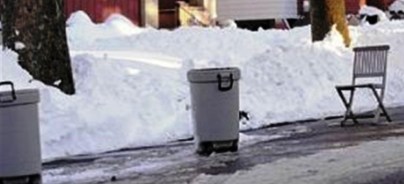
When I moved to the south, I left behind what is known as Trash Can Snowstorms. Now some of you reading this know exactly what I am talking about but for those of you who do not, an explanation is needed. A trash can snowstorm is when you shovel out your car and then reserve your spot with your trash cans (lawn chairs are also acceptable). Is it illegal? Yes. Is it enforced? No. Do you dare move someone’s trash cans and take the spot? Not if you value your life and your car.
Trash Can Snow
This is what I would call a trait of the cultural landscape; something you only see in particular geographic locations. I now have access to a whole new group of cultural landscape imagery. The first one I noticed here is the School Rock. I do not know if this is a southern thing or a North Carolina thing but it seems that all schools have a giant rock out front that is continuously painted with the name of some student highlighting something about that person: a birthday, a sporting victory, etc. Fortunately, my friend Erin’s son, Cooper, just had a birthday and they photographed the rock they painted so you can see what I mean. As you can guess, Cooper likes baseball.
School Rock, Lincoln County, NC
I am going to continue to look for new cultural landscape images but want to share a favorite one from my past life: the sneakers on the electrical wire. Are there cultural landscape signs where you live? What are they?
On our walk last week, we passed a dilapidated shed with a pink flamingo gracing its space. One of the members of the group commented that yard ornaments were not allowed in her neighborhood.
Because I lived in a very old house in a very old neighborhood, it was not until I moved to a very new area in a very different part of the country that I encountered this peculiar entity that now comes with home ownership: The HOA. For those of you as clueless as I was, HOA stands for Home Owners Association. The HOA was created as a way to assure residents that a certain level of standards are met to maintain housing values and quality of life.
At first, this idea had some appeal to me. In old city row housing, you are connected up close and personal with your neighbors and I was plagued with quality of life issues. Weeds over 7 feet high, stagnant water collecting and attracting mosquitoes, neighbors sneaking illegal dumping into your trash can (always be aware of who is breaking up concrete as you are bound to find it in your trash), garbage thrown into your yard, used condoms and drug paraphernalia on the other side of your yard (if you were lucky, if not, this would be in your yard too), illegal businesses and questionable activity going on in the driveway, and, the thing that really got to me most, neglected pets (fortunately, other neighbors would often also rally to help in this case).
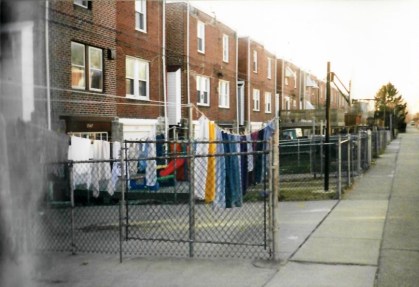
Yards attached to row housing
So if there is an organization that can prevent all of that, sign me up! But as I learned more about HOAs, the less appealing they sounded. First, many HOAs have strict regulations about what you can and cannot do with the outside of your home. That may include something as innocent as a vegetable garden. My old yard, which was a native plant and bird habitat, would be frowned upon in many HOA communities. Hanging out laundry is a big no no. Also, there are fees that go with HOAs and those fees may go to pay for things that you may not use or may be morally against. For example, many HOA fees go to pay for lawn care. Lawns and the care that goes into them are one of the biggest environmental problems we face. This is a great surprise to many homeowners and I am not going to get into the reasons why here, but I do know that I will not support such fees. The other thing, if you are buying a property in a community that has an HOA, the seller is not obligated to disclose the HOA agreement to the buyer, which is often hundreds of pages long anyway. How do you know what you are getting into? Lastly, there is the irony of the HOA as a potential infringement on the glamour associated with home ownership and individualism.
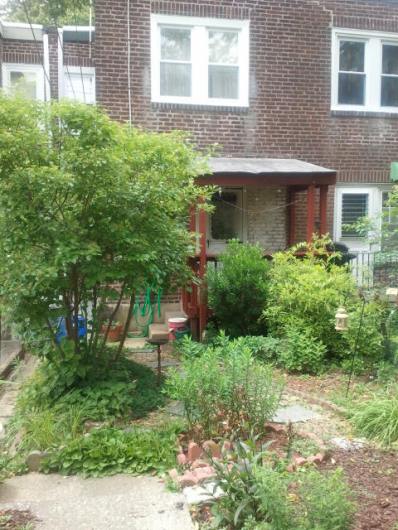
My former backyard, Philadelphia, PA
Right now, we are renters so such questions can be put aside. But at some point in the future, we may have to decide if we want to live within the rules of an HOA or take our chances elsewhere. The real deciding factor will be whether or not we can put out a pink flamingo.
The Other, 2018, Mixed Media on Paper, Collection: Free Library of Philadelphia
It’s odd how things come in clumps. Or maybe we are just more tuned in when we are engaged with a particular topic. Not long ago, an opportunity arose to participate in an exhibition honoring women of the Civil Rights Movement. What immediately came to my mind was a piece I had been working on called Making the Dress. While not really about Civil Rights, a large influence on that piece was the sacrifices women have made to support their families, often in the clothing and textile industries. While some women worked from home doing mending and tailoring, others faced terrible working conditions in factories. A particular tragedy that comes to my mind when I reflect on this is the Triangle Shirtwaste Fire of 1911. The curator of the exhibition was very gracious and said she would include my piece and asked me if I had any other work. While I did not have any pieces on the Civil Rights Movement, I realized that I have made work in the past that subtly addressed the topic of race relations.
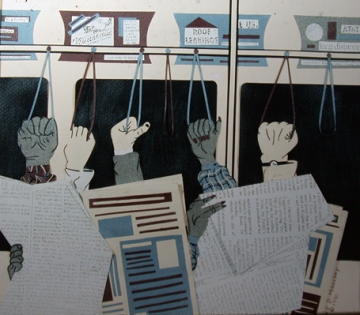
I had made a series of drawings and linocuts back in the 1990s that included generic faces which were always multicultural. It was sort of my way of saying we are all human beings and here together. In addition, I just recalled today that the first commission I ever had was for an organization called the Frankford Human Relations Coalition. I made a cut paper collage of various ethnic groups of people engaging in chatting, playing jump rope, etc. I have no record of this piece but it was made similarly to the image below of the people riding the subway. Again, not a big statement, just a way of showing people living together going about their daily lives.
This post is dedicated to my dear friend “Chief” Nancy
Several years ago, I embarked on a project called “Silent Echoes”. It involved noticing how people used the space around the outside of their homes, and also refuted the common belief that every row house is exactly the same. Below is the text that was written for the project and the slide show underneath shows pairings of different photographs. Oddly, I just realized this project was completed 20 years ago and I feel it is still relevant and relates to ideas presented in the Cookie Cutter House Project.