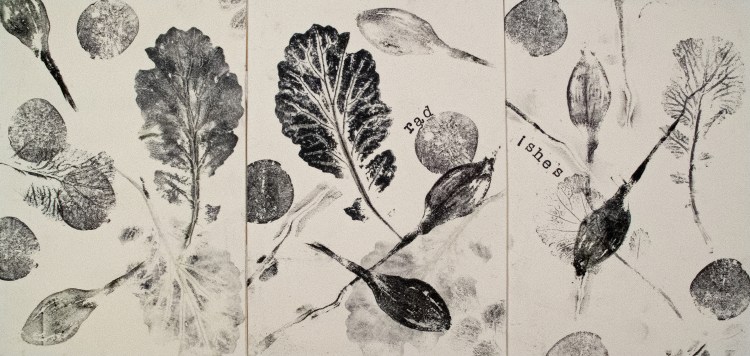
Radishes, from the artist book Diary of a Vegetable Farmer
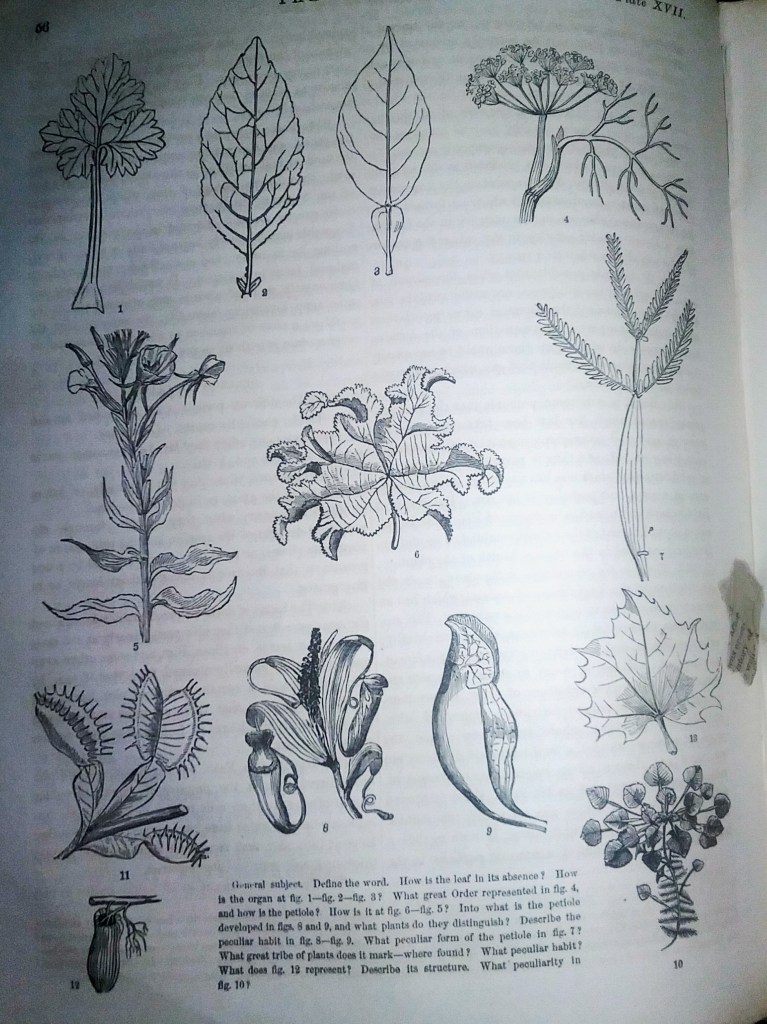
You do not have to be an artist or an expert on plants to enjoy this upcoming series hosted by the Plastic Club. It will kick off this Sunday with a presentation I am giving on looking at the characteristics of leaves with an emphasis on trees. Many people enjoy plant journaling as a way to relax and/or a way to learn about plants. This presentation will touch on this topic as well. It may lean a bit more towards the botanical than the art end of things but if you have any interest in plants I hope you will join us. And, we are looking for future speakers so if you have information to share on plants please consider becoming a presenter. The link to sign up for this Sunday’s event is here.
This may seem like an odd combination of things but it is because last summer I gave a summary of a week’s activities and it was a week that we cleaned the carpet. Well, it is carpet cleaning day again so I figured that was a good reason to repeat that format and fortunately it will be minus an earthquake.
Winter is Approaching, mixed media on panel, 12″ x 12″
Starting above with a painting I have been working and struggling with for the past few weeks. Well, I was able to complete that and am pretty happy with it. Last year I was volunteering at home mounting plants. Now I am employed at the herbarium so I spent a few days there and I am still trying to adjust to a new work schedule but that is coming along fine.
“chopped” version succotash
So what is this? Well, I find it to be great fun to take a bunch of vegetables that are in too small amounts to do much with on their own and make different blends of succotash. Aside from the show Chopped, the other inspiration I have for this is my Dad who used to clean out the refrigerator, add eggs, and scramble them with all the leftovers and called it Jambolt. Jambolt is an actual dish but it seems that is is one of those things that varies depending on the household. Well, succotash is sort of the same. My base for my Jambolt/Chopped succotash is thankfully NOT eggs but corn. For this version I had a little leftover radishes, red onion and spinach from our lunch this week and I am a big believer that a little olive oil, salt, and pepper are the the essentials to any type of vegetable dish. So to that I added a dash of cayenne and a little sweet paprika. Succotash.
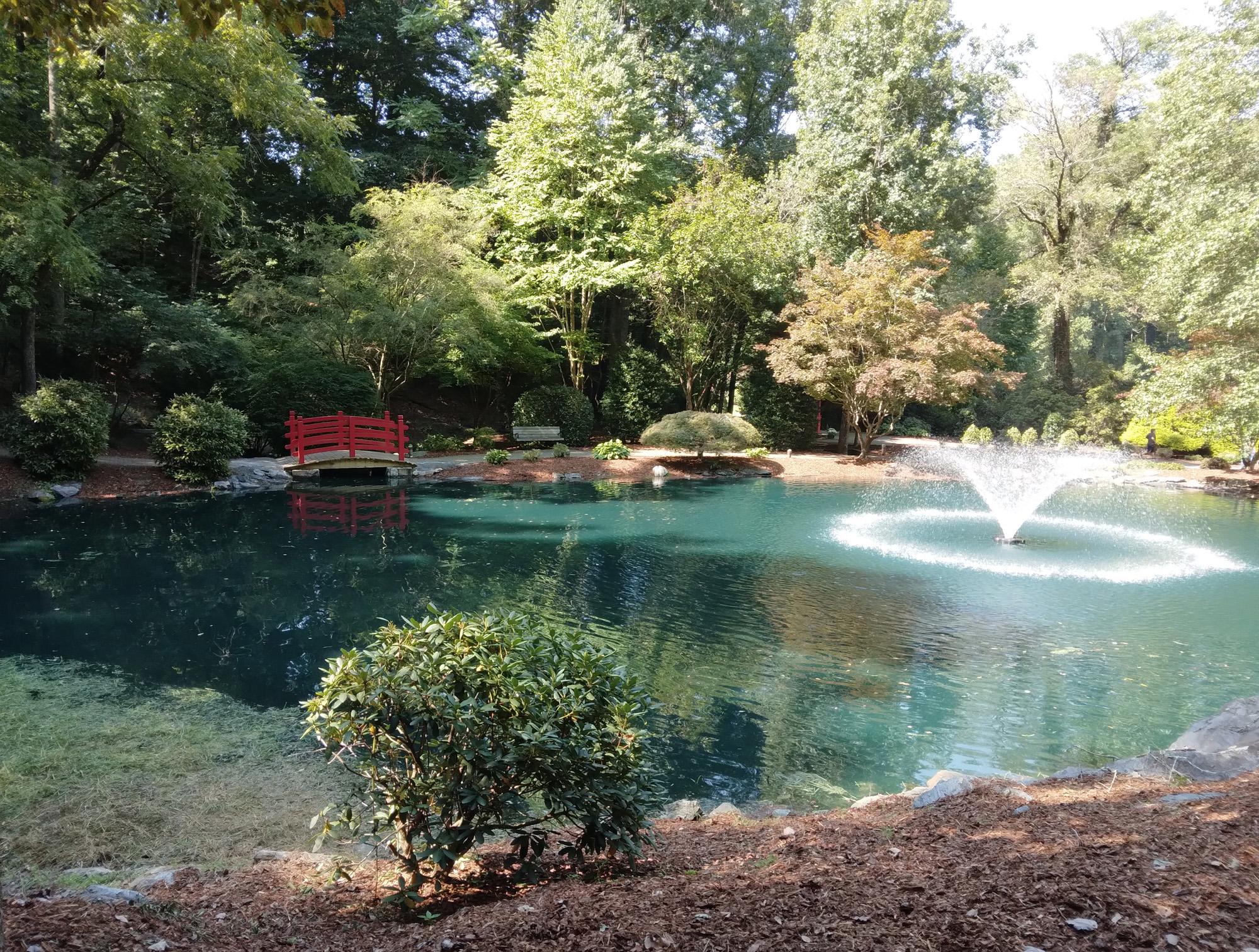
The above images are from a sculpture show we went to last Saturday at the Boyhill Walking Park in Lenoir, NC. We were really not sure what to expect and decided that if we didn’t feel safe we would just not attend. Our reluctance was based on many things but I won’t get into that here. It was only about an hour away so at the very least it was a nice ride. But we were pretty sure it would be fine based on some research we did. As you can see, it is a lovely setting and it was not very crowded. There were about 35 sculptors and they were arranged around a lake. Most of the sculptors wore masks and we put ours up if we approached them to talk. We were really glad we took the chance and went. Each artist was allowed to display up to three sculptures. My favorite sculpture is below.
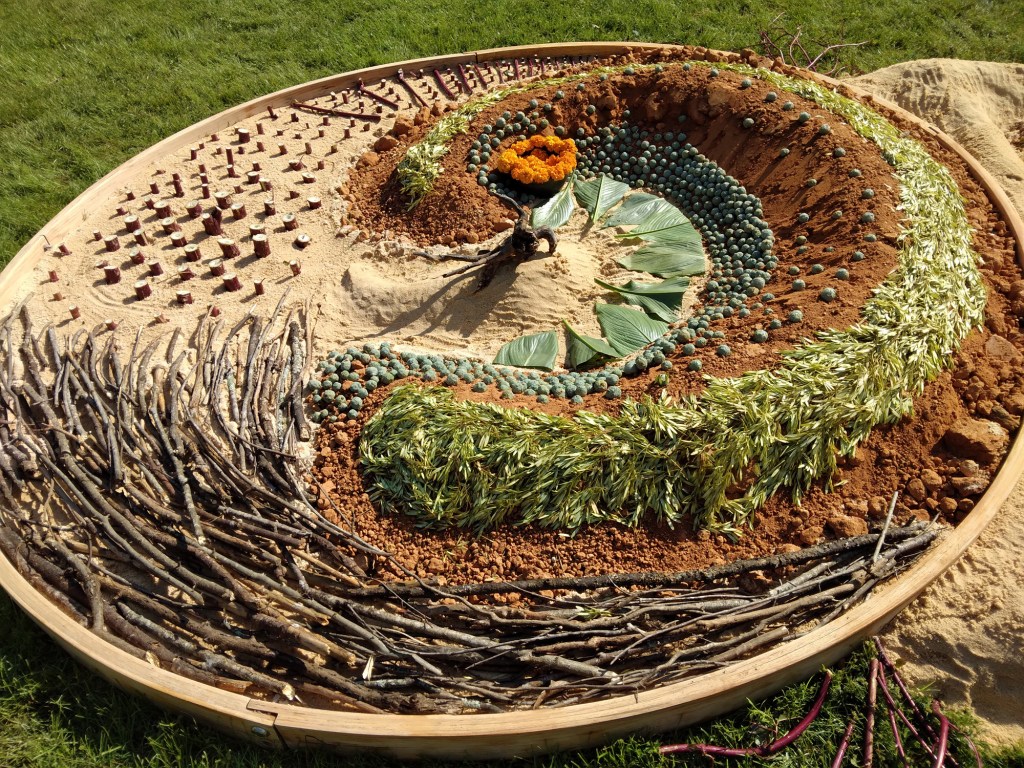
A Sculpture by Crista Cammaroto
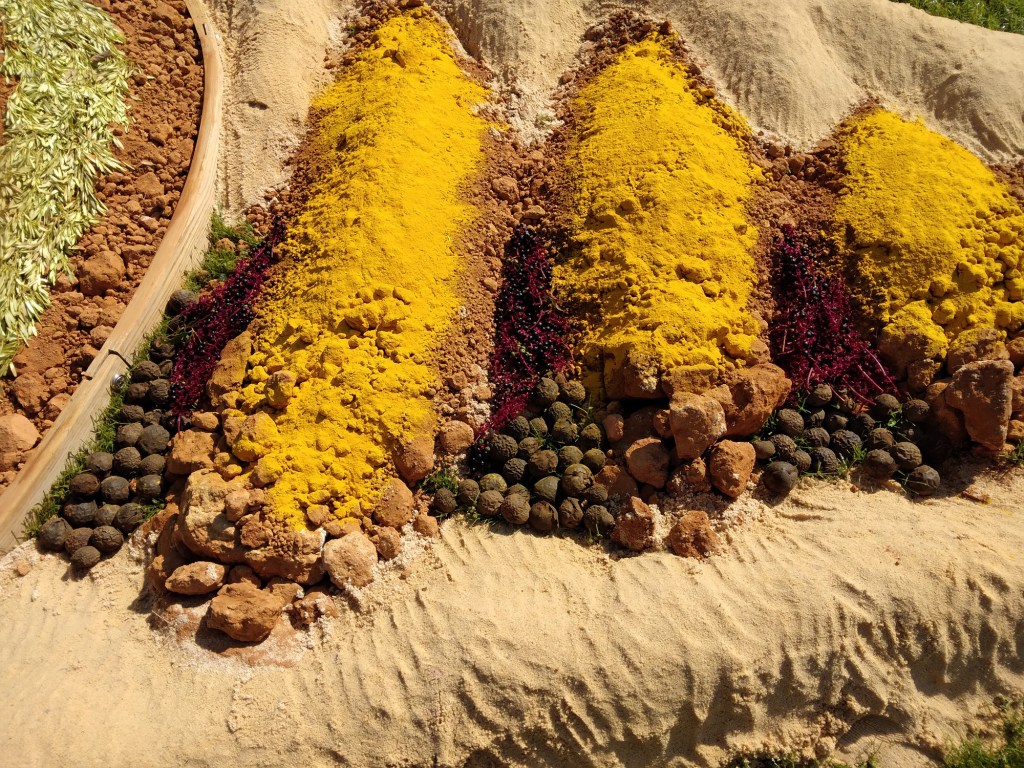
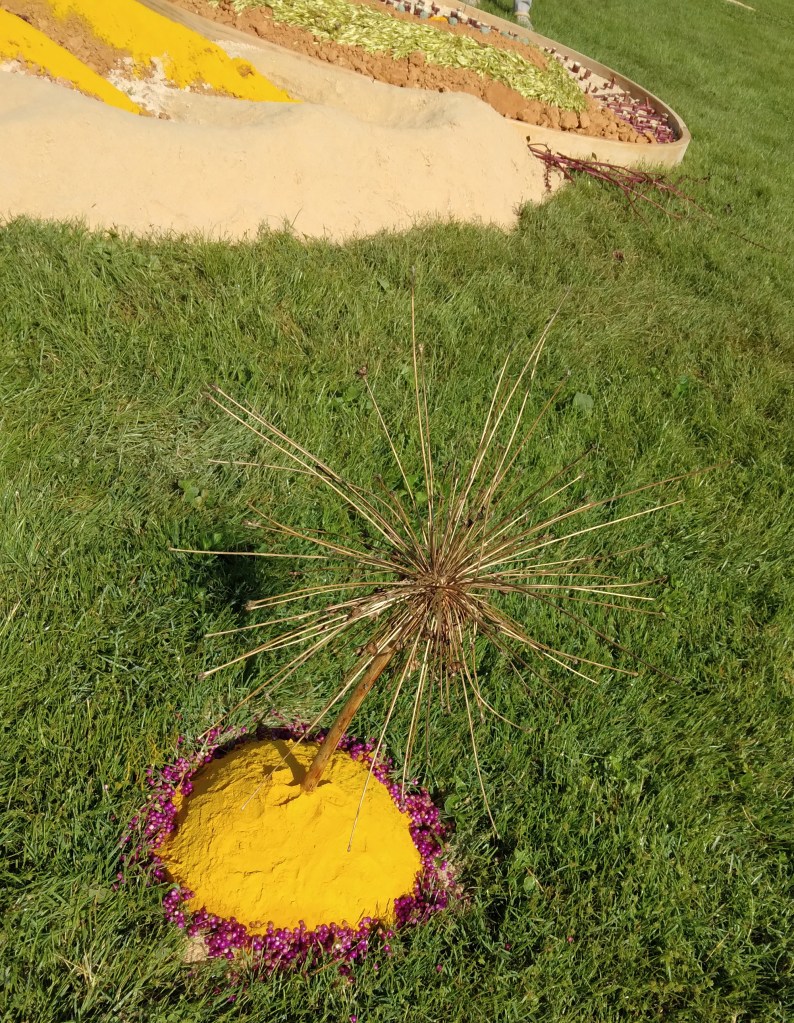
This wonderful installation by Crista Cammaroto was made out of all natural materials and is on a sand base. It was quite large and some details are above (you can right click on any image and it will enlarge in its own window). The yellow mounds were tummeric and you could smell them big time. She must have been there in the middle of the night setting this up. There was another one but my photos of that did not come out so well.
Earlier in the week I was able to safely attend an organ concert. An organ concert is not like going to see a rock band as they attract a relatively small, particular demographic. I love sitting in the back row of this big cavernous church and dozing off. It is very meditative. There was plenty of social distancing, even for the people who sat way up front. It is in Davidson which is, as a rule, concerned about safety and has a high vaccination rate so I feel pretty confident about anything I do there.
So though we are creeping along, I truly believe we are in a better place than we were a year ago for many reasons. And things will slowly improve as time goes on. I believe it was necessary to have this set back because people were getting too lax too quick, forgetting that many children are still not eligible for vaccines. I, for one, was struggling with the idea that a light switch turned and everything was normal again. That actually felt more strange to me than this slower adjustment.
Of course, the carpet is now clean. And the upholstery.
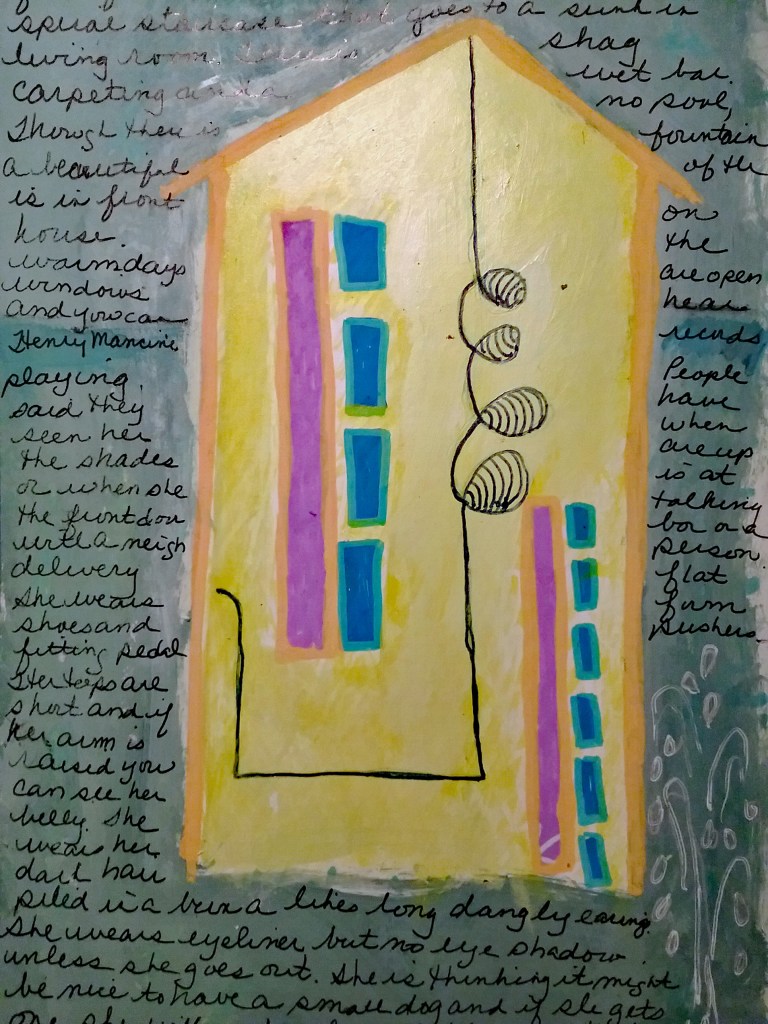
I am posting this at the insistence of a friend that urged I share it. I don’t know what made me think of this song recently but I did and was compelled to draw and write the following (see a typed version of the text under the image):
The text reads:
This is where the girl from Ipanema lives. The location of the house is unknown but many of the features were made public. It has a spiral staircase that goes to a sunk-in living room. There is shag carpeting and a wet bar. Though there is no pool there is a beautiful fountain in front of the house. On warmer days the windows are open and you can hear Henry Mancini records playing. People have seen her when the shades are up or when she is at the front door talking with a neighbor or a delivery person. She wears flat shoes and form fitting pedal pusher pants. Her tops are short and if her arm is raised you can see her belly. She wears her dark hair piled in a bun and likes long dangly earnings. She wears eyeliner, but no eye shadow unless she goes out. She is thinking it would be nice to have a small dog and if she gets one she will put a fancy collar on the dog and get a leash with tiny rhinestones.
***
Oddly, when I went looking for a version of this song to post I came across an interview with the actual woman this song was written about. She actually has (did have) dark hair and she obviously does like long dangly earrings and does like eye makeup. When the interviewer asked her what version she liked of the song, which was written by Antonio Carlos Jobim, she said the one by Frank Sinatra which, oddly, was not the most popular version of the song. However, in her honor, I will post a link to a version of the song (click here) done as a duet by Frank and Antonio.
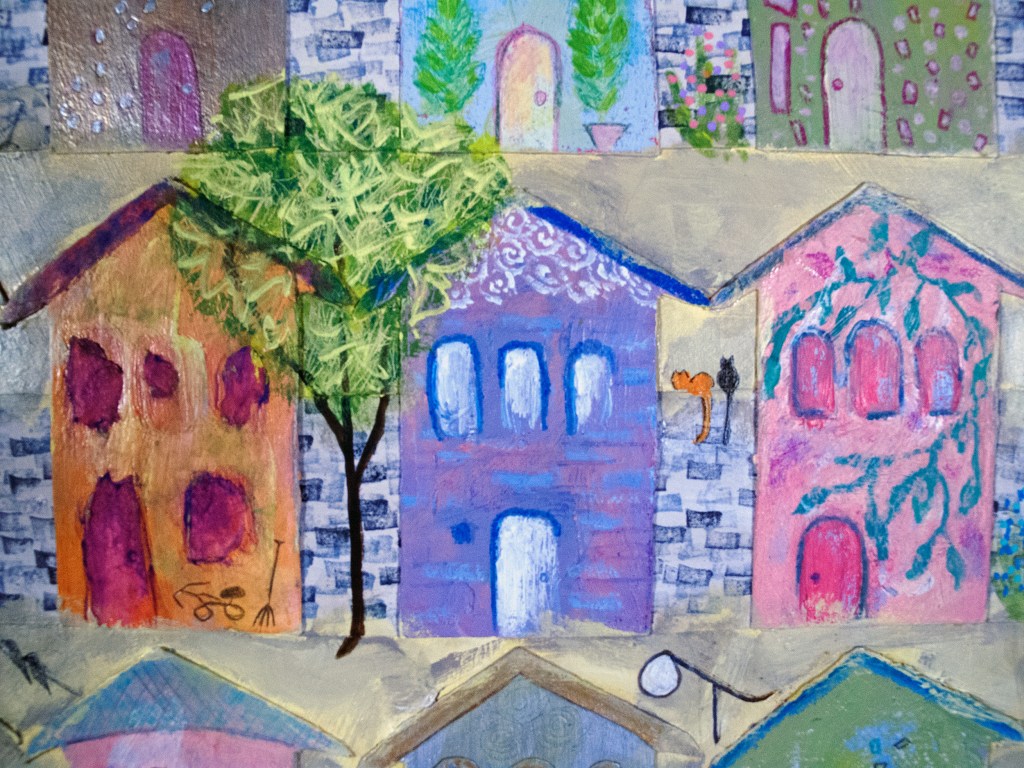
I have been working on this piece for several years now. For awhile, it lived on a dowel and each house was on a string. But after awhile, that seemed awkward to display. Then I thought about making it a book and made fences to help the houses to connect together and stand up and then changed my mind. This is now how the houses will live. The houses and fences are adhered to a 24″ x 24″ paint panel. There is additional painting and drawing on top so it is a mixed media piece. Some detail images are below.
The Neighborhood – DetailThe neighborhood – DetailThe Neighborhood – Detail
I had never heard of a Burr Oak (Quercus macrocarpa) before a recent class I took. The reason the tree stood out to me was its acorns which looked little winter hats with fuzz around the rim. Since these trees seem to grow in climates somewhat colder than where I live this seemed sort of fitting to me in an odd way and I secretly wondered if “Burr” had anything to do with what the tree was thinking such as “Burrr, I’m cold. I need to make some more fuzzy acorns to keep warm”. Ok I know this is getting silly.
Anyway, I have been amusing myself lately trying to identify various oak trees that I come across. I was at a local nature preserve and noticed a number of oaks growing near the former welcome center. I pulled out my handy tree key and started trying to figure out what they were. One tree keyed out to be a Burr Oak. Hmmm? That seemed odd to me; maybe I mis-keyed it. Below is a rubbing I took of one of the leaves. It certainly looked like a Burr Oak leaf. But I was still skeptical.
Burr Oak Leaves
Moving over a few feet to key some other oak trees on the grounds, I noticed a lot of leaf litter and other debris at the base of the trees. It is also good to look at this for some additional clues such as acorns, other fruits, flowers, etc. There in the leaf litter was this odd looking thing; I didn’t know what it was. So of course I picked it up. It was certainly very large and unusual looking. Then a lightbulb went off in my head: A Burr Oak Acorn!
Cap of a Burr Oak Acorn
Finding this cemented that the tree a few feet to my left was indeed a Burr Oak! The diameter of this acorn cap is about 1.5 inches- pretty big. Though this explains the botanical name: Quercus (the genus for all oak trees) macrocarpa, which means “large fruit”. Below is my sketch of the cap of the acorn with the live model.
It is daunting when you are learning to identify plants to decipher between a simple and compound leaf. At times, compound leaves are also referred to as Divided leaves. For this article, I will stick to the term Compound Leaves/Leaf. The suggestion usually made is to look for a bud at the base of the leaf stem (another name for a leaf stem is ‘Petiole’). At times this is sort of easy to see but not always because some plants, especially trees are, well, leafy!! So with the photos below I will attempt to explain how to identify if a leaf is compound.
For our purposes here, we will use an Ash Tree (Fraxinus spp). Ash leaves have three characteristics: they are opposite one another, their margins are what is called Entire (no teeth or lobes), and they are compound. I have three photos to share and I will number them because I will most likely refer to some more than once.
PHOTO 1
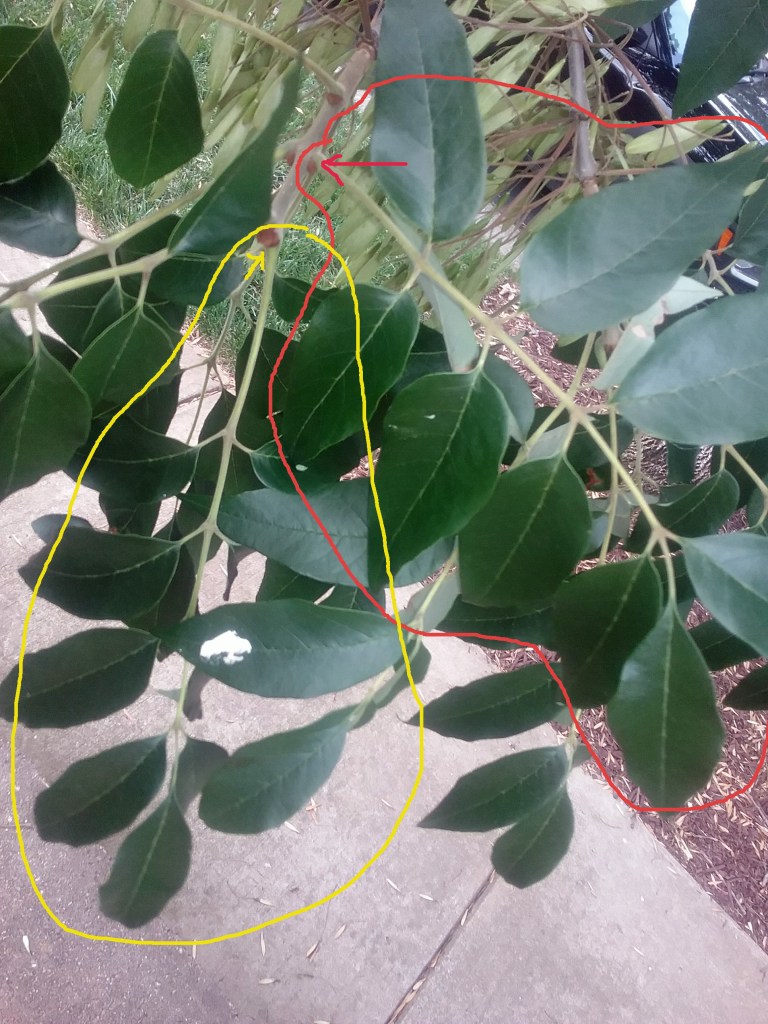
Above (Photo #1) is a view of two Ash leaves: one encircled in yellow and one encircled in red just to differentiate because they overlap a bit. You will notice that each leaf is comprised of several structures of what seems to be leaves as well but they are not leaves, they are Leaflets. So how do you tell this? Yes, it does have to do with a bud at the leaf base but I have some photos that clearly show this.
PHOTO 2
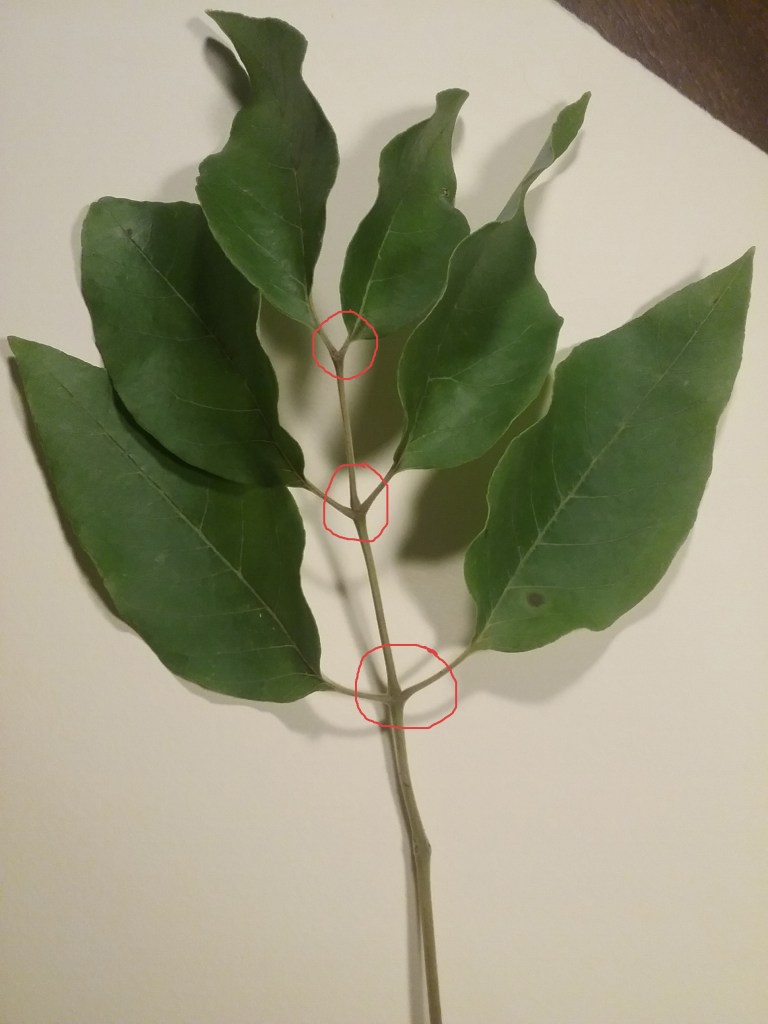
The above photo (photo #2) shows the sets of leaflets on this particular leaf. I circled the base of each pair of leaflets and if you look at that area you will not see any protruding growth (no buds peeking out).
PHOTO 3
Above (Photo #3) is a view of the base of a few pairs of leaves circled in red. Notice the buds at the base where the stems of the leaves meet the developing twig. If you go back and look at Photo #1 at the top of this post, you will see I put an arrow at the base of those leaves to show the buds.
A few other things to mention – notice that the leaves are opposite one another and the leaflets are also opposite. This particular structure can be further characterized as a Pinnately Compound Leaf. I will not go into that here, but I choose this structure because they are a bit easier to decipher than another structure of compound leaves which are called Palmately compound leaves. We will look at those another time.
Any questions, feel free to comment or contact me. I hope this was of help to anyone interested.
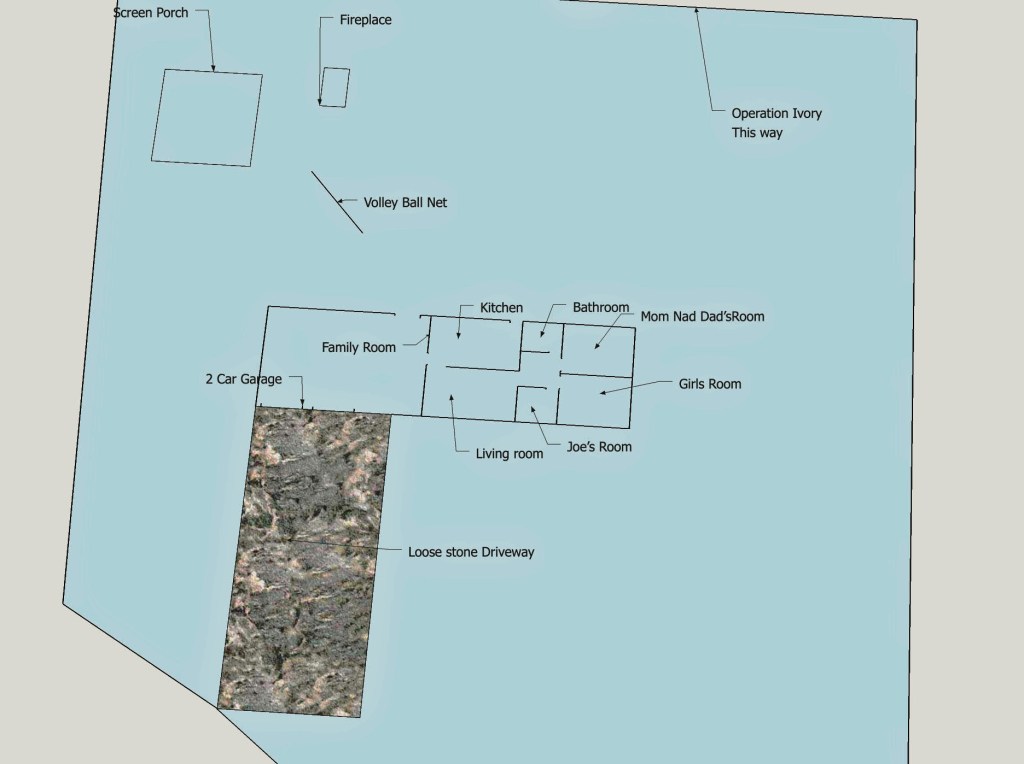
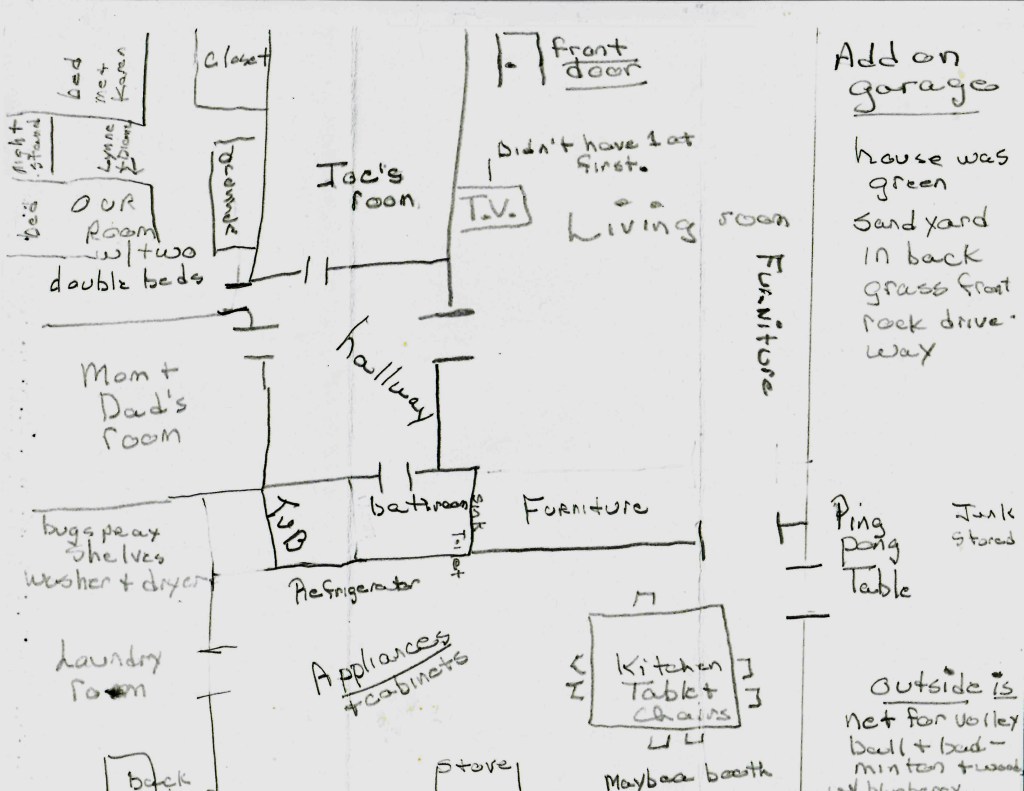
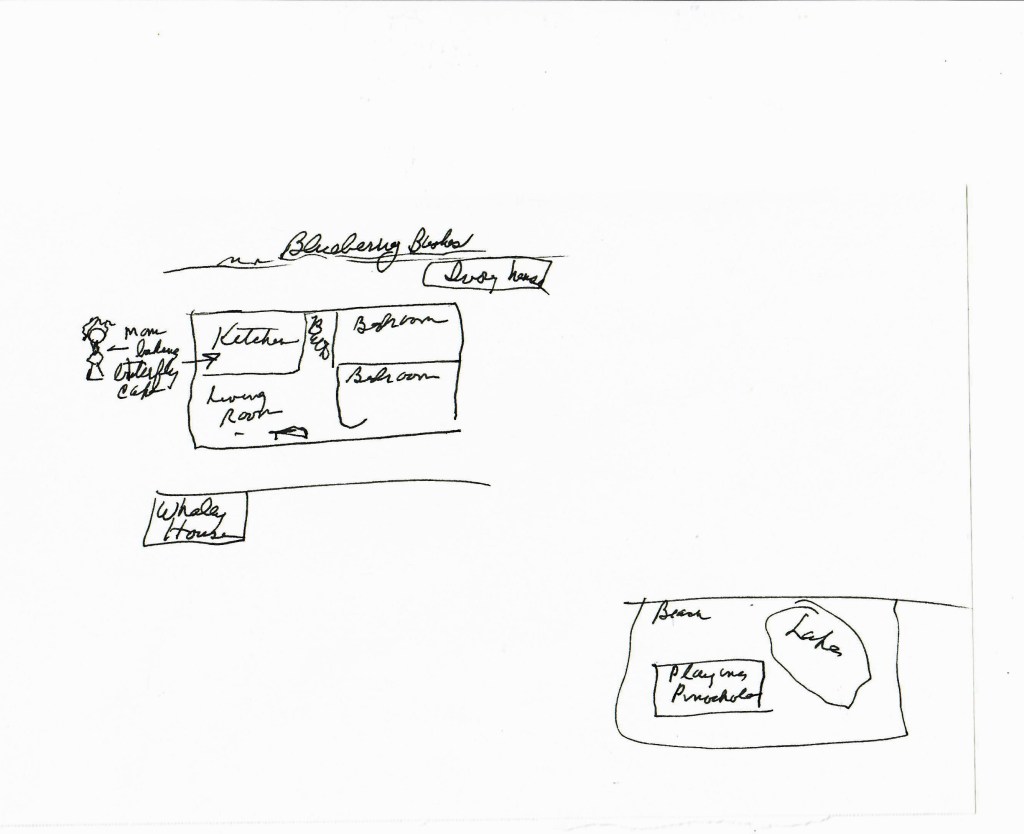
Before I show the five diagrams below, I must give some background information. In the mid 1950s, my parents were given the opportunity to rent a house for the summer in a small lake community for a total of $5. At the end of the summer, they had the option to purchase the property. It was a ranch house on approximately 1/4 acre of ground. A man-made cedar water lake was within walking distance. My parents did end up buying the property at the end of the summer. Our family went there every summer for many years. I was not yet born when they bought this house and am several years younger than my brother and sisters so my recollections of some things are quite different. However, we had many similarities as to what we remembered regarding the look of the house, property, and community. I asked my brother and sisters, without consulting one another, to draw the “Lake House” as they recall it. I have each diagram below and will decipher what is written. As for my drawing, there is no writing which is something I find interesting in and of itself. So for the purpose of describing my drawing, I inserted numbers via photoshop so I can refer to the various things I included. After I insert all the diagrams and descriptions, I will go over some similarities that were depicted as well as some that were discussed after the drawings were completed.
1. Mail box with flag on it, which I found odd. 2. A three trunk tree that I used to hide in. 3. The house itself, represented by this line. 4. A ping pong table in the addition that my parents eventually put on the house. 5. The nook kitchen table which barely held our family let alone the additional people that always seemed to be there at dinner. 6. A stove with a built in Dutch oven. 7. The Utility Room and back entrance. 8. An outdoor shower and water fountain. 9. The crawl space. 10. The central heater which was located in the hallway of the house. 11. An outdoor fireplace. 12. The picnic house that was filled with junk. 13. A swing set, very rusty but usable. 14. My playhouse. 15. A Zip line my brother made, but they were not called that at the time.
This is pretty self explanatory as far as me not needing to decipher handwriting. “Operation Ivory” refers to our neighbors.
So this version is quite detailed with lots of descriptive text. Most of it is pretty easy to read but because there is so much text I will highlight a few things. In the lower right hand corner there is a mention of a net for volley ball and badminton and blueberry bushes (this text got cut off). Above that the ping pong table is mentioned. Above that the rock drive way is indicated. In the kitchen area, below the kitchen table it says “maybe a booth”. Next to the kitchen, there is a mention of a laundry room and a “bug spray” shelf. There is great detail in the bedroom marked “our room” and there is mention of a TV that was put in at a later date.
This version uses diagrams and text. Since the text is sparse and some of it indecipherable, I will just do a recap of all of it. The upper part of this recollection is the house and yard. Attention is give to the badminton/volleyball net and rocks both in back of the house and in front of the house. There is also mention of weeds in front of the house. The lower part of this drawing depicts the community at large, including neighbors we had “Nancy & Jack” and “Cohens”. The Lake diagram also include a square marked Dance/church because that building served as both a community hall and where church services were held. The beach is also indicated.
This also includes a diagram and text that is indecipherable for the most part so I will translate this too. The lower part of the drawing indicates the beach, the lake, and a square that represents a blanket where pinochle was played. The “Whaley House” is the same as the “Nancy & Jack” house mentioned above as is the “Ivory house”. The top portion of this diagram shows blueberry bushes, a diagram of the house and a figure which is my mom baking a butterfly cake which is a reference to the shape of the cake, not the flavor.
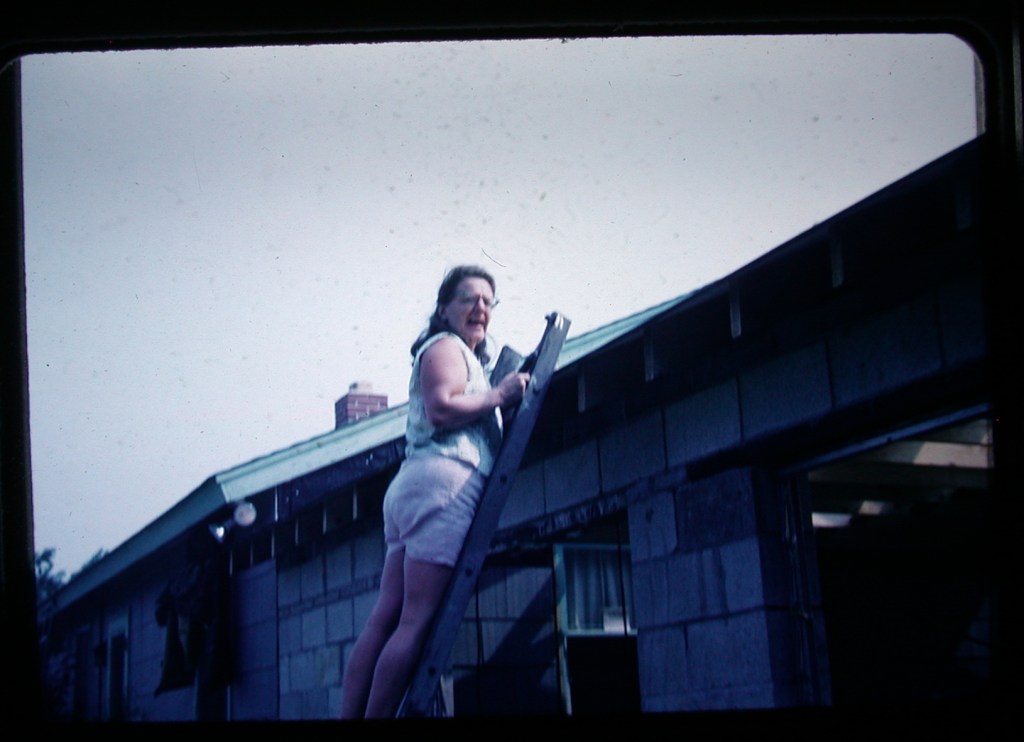
Here are some actual photos I found. Shown below are my Mom, Dad, and brother working on the roof the the addition to the house. The other picture is of me in the Lake.
Things that were remembered by and large either in the diagrams or the conversations after the diagrams were drawn:
The various neighbors and playing cards
Picking up rocks in the yard (I have no recollection of this but it was big on the list of everyone else)
The net outback for volleyball or badminton
The blueberry bushes
The general layout of the house
The addition that was built
The Lake itself and the community house
One thing that now strike me as particularly interesting is the fact that we had no phone. Since both my parents worked shift work, it was not unusual for them to call and it was anyone’s guess which neighbor would be knocking on our door saying we had a phone call. I could go on with many things I remember about this place but I won’t. I will add that it seemed like about a million miles away and an endless drive from our house in Philadelphia but I just checked the map and it is only 40 miles. I also now leaned, after 60 some years, that it is Badminton and not Batmitten.
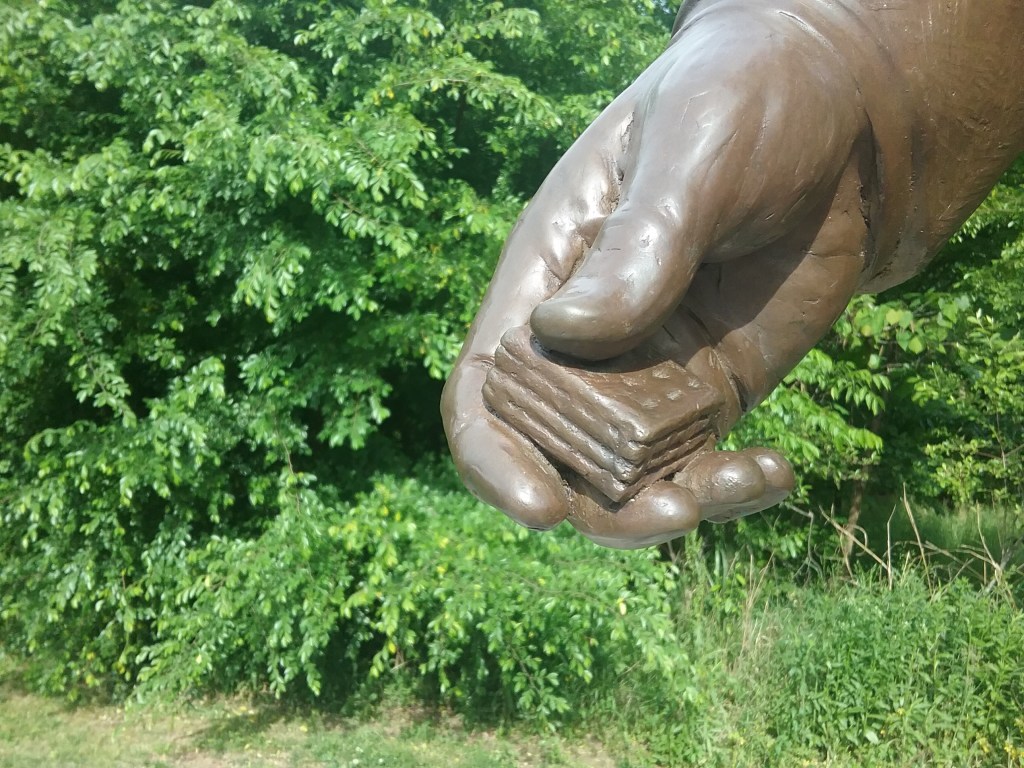
Last week we went for a walk on a local greenway that features statues of prominent citizens from the area. While we did not get to see all the statues, the ones we did see were informative and impressive. The one I am choosing to feature here is because, though it is a local figure, what the person stands for has national significance. A great thinker? No. A great artist/poet? No. A great historic figure? No, not in the true sense of the word. Give up? Ok, the mystery person is the guy responsible for Lance peanut butter crackers.
What we especially got a kick out of was the statue itself with hand extended offering some peanut butter crackers to joggers and pedestrians as well as the pedestal on which he stood which was, of course, a peanut butter cracker.