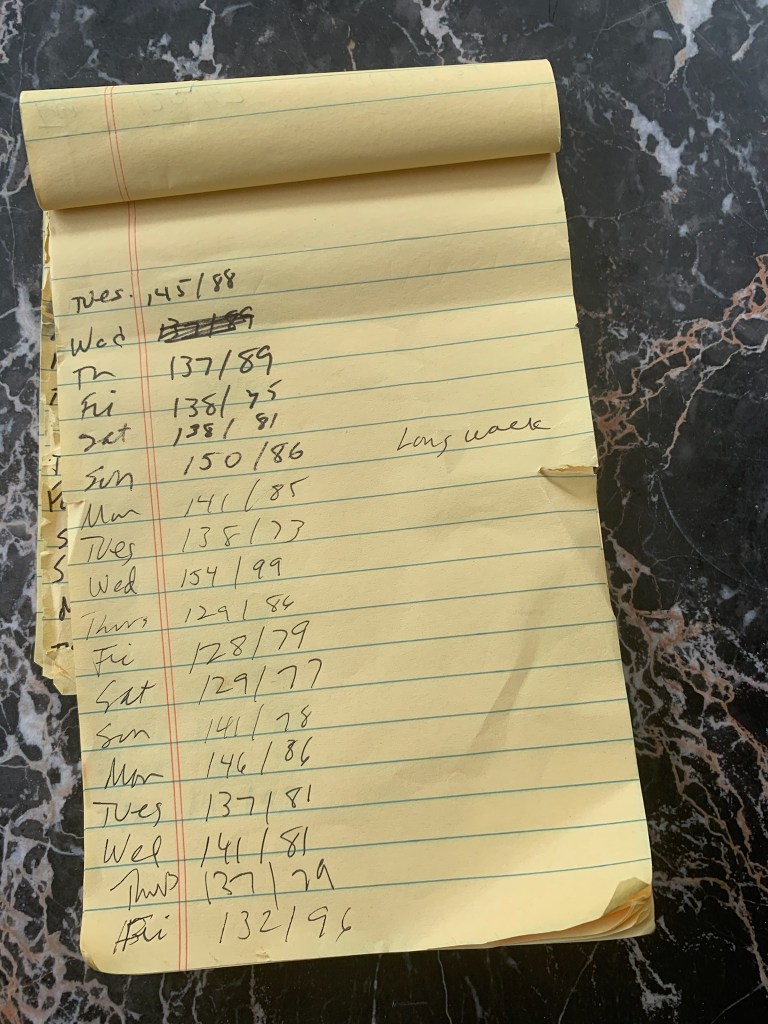
A friend of mine was keeping a journal recording her blood pressure. On a follow up visit to her doctor, she presented him with the journal. As he looked at it he started to chuckle here and there. Then she remembered that along side of some of the pressure readings, she made notations such as “angry” “not enough sleep”, etc. Here is one particular page with a notation from her journal that she said I could share.
To learn about this project, click here. This post is organized this way – the grocery lists, information & facts on food insecurity, resources, and anonymous general information about the people who submitted the lists published. Looking for ways to help out? Check with you local school district or houses of worship to see if they sponsor backpack or grocery bag programs. Check online for organizations such as food pantries, food banks, and soup kitchens that collect food in your area. A list of such organization is being compiled below and will be added to each week.
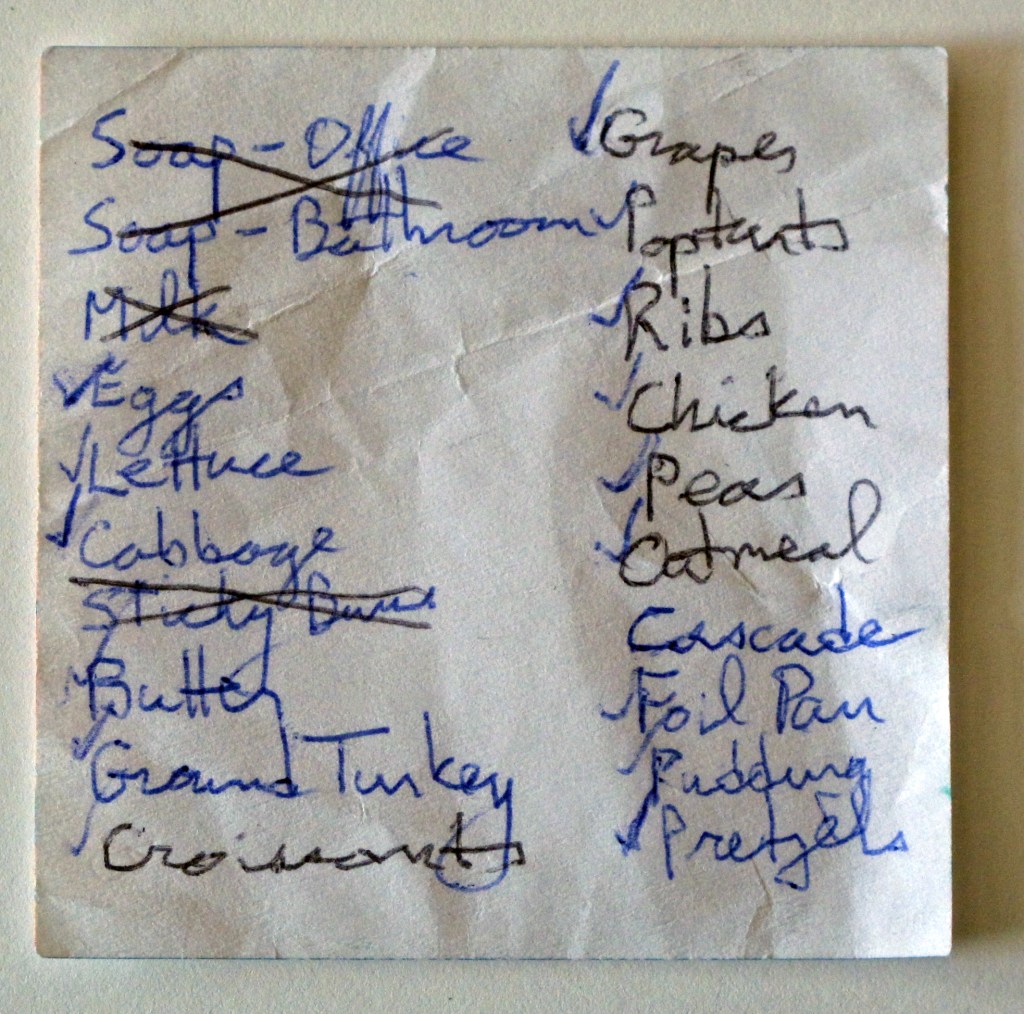
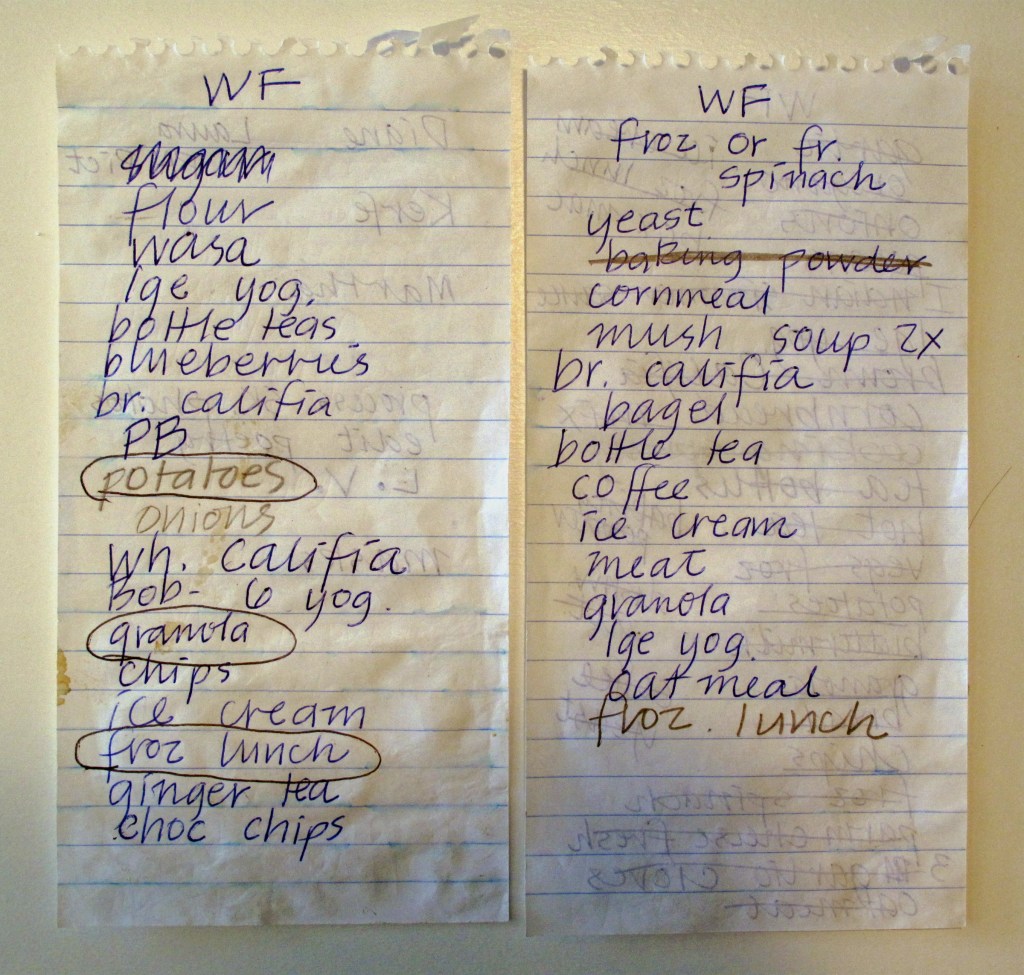
Some of the crossed out items on this week’s lists include: (TOP LIST) brown rice, honey, ground beef, taco seasoning, sliced turkey, coffee creamer, milk, liquid hand soap refill, vegetables, sausage, pickles, mayo, corn chips, flour, sugar, cornmeal, canola oil, lettuce, tomato, eggs, bread, salsa, black beans, green onion, red onion, tomato paste, limes. (BOTTOM LIST) Milk, sticky buns, soap for office and soap for bathroom.
Helpful Hints when Donating to a Food Program:
*If you garden at home or with a group, consider sharing some of your crops with the local food pantry or soup kitchen.
*Remember that hamburger helper does not help if there is no meat. When donating peanut butter, also consider crackers or bread to go with it.
*Consider donating some pantry staples such as cooking oil, which is needed for a great deal of food preparation, as well as items like sugar, flour, spices, coffee & tea.
*In addition to food, items such as personal grooming products are also needed as well as things like dishwashing detergent. Make sure to donate full size items unless there is a particular reason the organization is looking for “hotel” or “sample” size items. It you are not sure, it is always ok to ask exactly what is needed.
*Food Banks are able to buy in bulk for very good prices so donations of money are always very useful, maybe even more useful than actual food. However, Food Pantries benefit from both actual food items and money. The difference between Food Banks and Food Pantries are as follows: Food Banks feed lots of people from a wide area, either directly or by supplying to soup kitchens and other community food programs. Food Pantries are locally based and address individuals’ needs in the immediate surrounding community. They are often located in churches, or social service agencies as part of larger missions. It is a good idea to check with your local Food Bank/Pantry to see what is most useful to them.
*When donating to backpack programs, choose canned items with pop off or peel off lids in case the recipient does not have or cannot use a can opener.
*When donating macaroni & cheese try to get the kind that is premixed so that no additional ingredients like milk, which may not be available, are needed.
**Dialing 2-1-1 will connect a person with information on local services that provide assistance.
Info from this week’s shoppers:
Each list this week represents a household of two adults. One participant learned to cook from her mother who was a trained home economist. Both households tend to eat at home, especially since the Pandemic. One participant cooks large meals and freezes smaller portions. One participant is from the Philippines where food insecurity is widespread. One participant grew up in the age of “frozen food and Jello”. One participant shops for bargains, particularly of meat and then breaks down the package to smaller servings. Both participants have access to farmer’s markets.
Tonight I will be listening to a talk on how to store your personal paper treasures. I have always be intrigued by ephemera – those odd scraps of paper and things people throw away (movie tickets, grocery lists, etc.) In fact, once I had the privilege of holding a job where a good chunk of my responsibility was going through such papers at the Urban Archives at Temple University.
Not long ago, a dear friend of mine came across some wonderful personal ephemera – the bill from the hospital when she was born as well as some other goodies related to the event! She very graciously sent it to me and allowed me to share it. Aside from the prices, I get a kick out of the simplicity of the address on the envelope. At the time, the area was very rural. And the least I can do in gratitude for her allowing me to share this is to also share the link to her website (truly one of the most gifted pastel artists of today) https://www.hvefinn.com/
To learn about this project, click here. This post is organized this way – the grocery lists, information & facts on food insecurity, resources, and anonymous general information about the people who submitted the lists published. Looking for ways to help out? Check with you local school district or houses of worship to see if they sponsor backpack or grocery bag programs. Check online for organizations such as food pantries, food banks, and soup kitchens that collect food in your area. A list of such organization is being compiled below and will be added to each week.
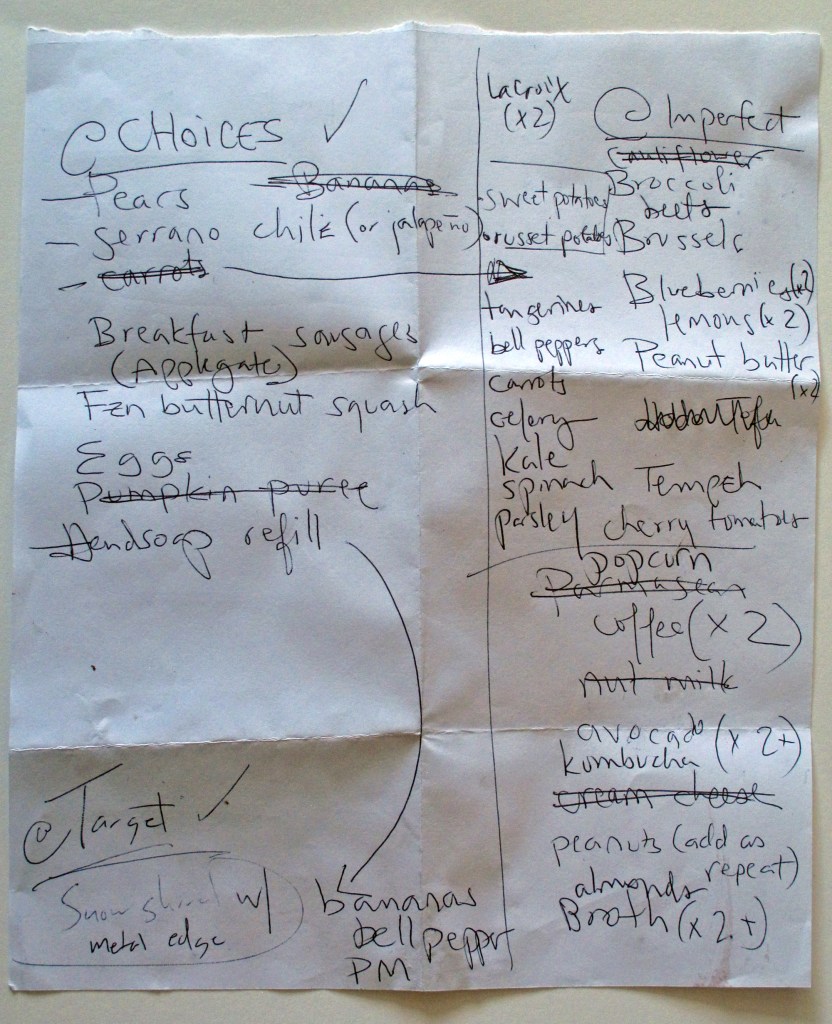
Shopper A is above, Shopper B below showing front and back of list
Helpful Hints when Donating to a Food Program:
*Remember that hamburger helper does not help if there is no meat. When donating peanut butter, also consider crackers or bread to go with it.
*Consider donating some pantry staples such as cooking oil, which is needed for a great deal of food preparation, as well as items like sugar, flour, spices, coffee & tea.
*In addition to food, items such as personal grooming products are also needed as well as things like dishwashing detergent. Make sure to donate full size items unless there is a particular reason the organization is looking for “hotel” or “sample” size items. It you are not sure, it is always ok to ask exactly what is needed.
*Food Banks are able to buy in bulk for very good prices so donations of money are always very useful, maybe even more useful than actual food. However, Food Pantries benefit from both actual food items and money. The difference between Food Banks and Food Pantries are as follows: Food Banks feed lots of people from a wide area, either directly or by supplying to soup kitchens and other community food programs. Food Pantries are locally based and address individuals’ needs in the immediate surrounding community. They are often located in churches, or social service agencies as part of larger missions. It is a good idea to check with your local Food Bank/Pantry to see what is most useful to them.
*When donating to backpack programs, choose canned items with pop off or peel off lids in case the recipient does not have or cannot use a can opener.
*When donating macaroni & cheese try to get the kind that is premixed so that no additional ingredients like milk, which may not be available, are needed.
**Dialing 2-1-1 will connect a person with information on local services that provide assistance.
Info from this week’s shoppers:
About this week’s shoppers: One list represents a family of two semi-retired adults and the other, a family of three with one school age child. One family has one member that is a vegetarian. Both families enjoy experimenting with flavors from other cultures and fresh vegetables. One family sources many of its fresh foods from local markets, CSAs, and businesses that deliver “ugly” produce that might otherwise go to waste. Both families have changed the way they shop during the Pandemic. One participant was regularly participating in local cooking demonstrations at their local library which changed their taste and the way they shopped.
To learn about this project, click here. This post is organized this way – the grocery lists, information & facts on food insecurity, resources, and anonymous general information about the people who submitted the lists published. Looking for ways to help out? Check with you local school district or houses of worship to see if they sponsor backpack or grocery bag programs. Check online for organizations such as food pantries, food banks, and soup kitchens that collect food in your area. A list of such organization is being compiled below and will be added to each week.
Helpful Hints when Donating to a Food Program:
*Consider donating some pantry staples such as cooking oil, which is needed for a great deal of food preparation, as well as items like sugar, flour, spices, coffee & tea.
*In addition to food, items such as personal grooming products are also needed as well as things like dishwashing detergent. Make sure to donate full size items unless there is a particular reason the organization is looking for “hotel” or “sample” size items. It you are not sure, it is always ok to ask exactly what is needed.
*Food Banks are able to buy in bulk for very good prices so donations of money are always very useful, maybe even more useful than actual food. However, Food Pantries benefit from both actual food items and money. The difference between Food Banks and Food Pantries are as follows: Food Banks feed lots of people from a wide area, either directly or by supplying to soup kitchens and other community food programs. Food Pantries are locally based and address individuals’ needs in the immediate surrounding community. They are often located in churches, or social service agencies as part of larger missions. It is a good idea to check with your local Food Bank/Pantry to see what is most useful to them.
*When donating to backpack programs, choose canned items with pop off or peel off lids in case the recipient does not have or cannot use a can opener.
*When donating macaroni & cheese try to get the kind that is premixed so that no additional ingredients like milk, which may not be available, are needed.
**Dialing 2-1-1 will connect a person with information on local services that provide assistance.
Info from this week’s shoppers:
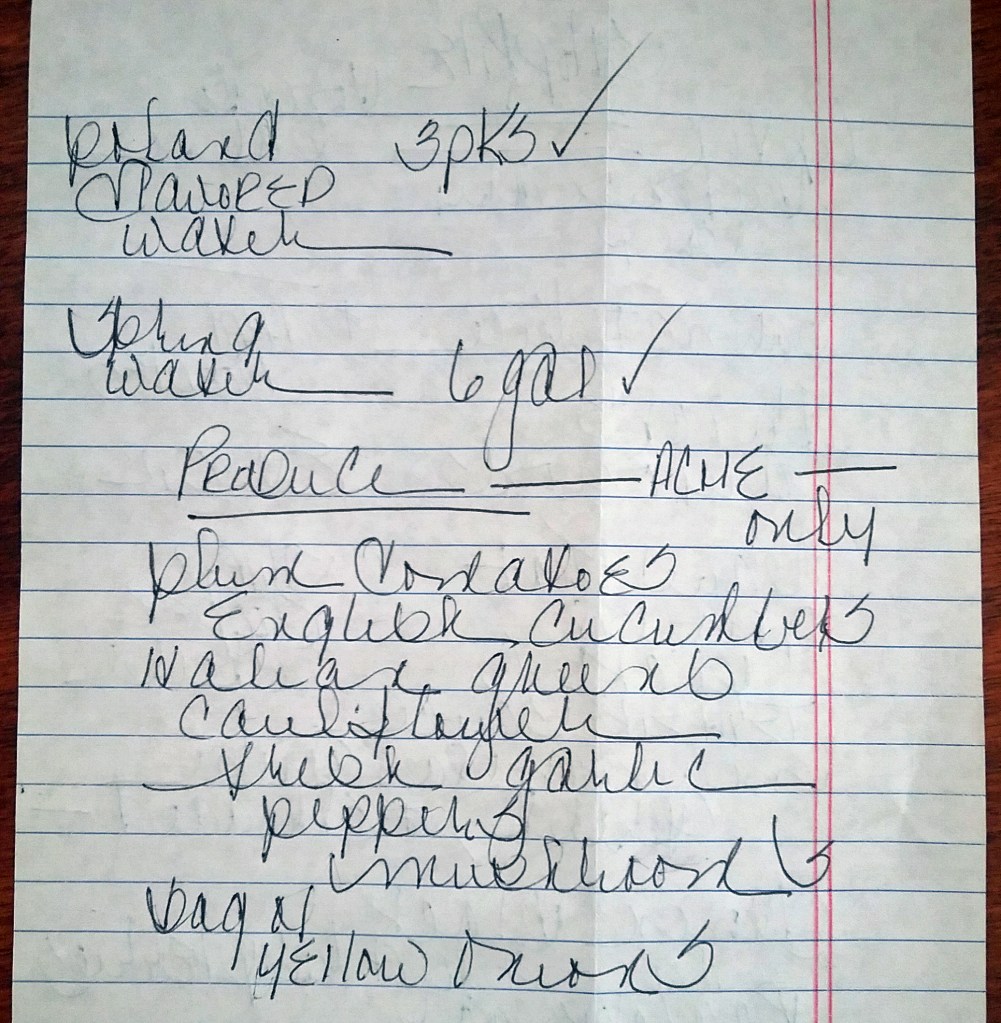
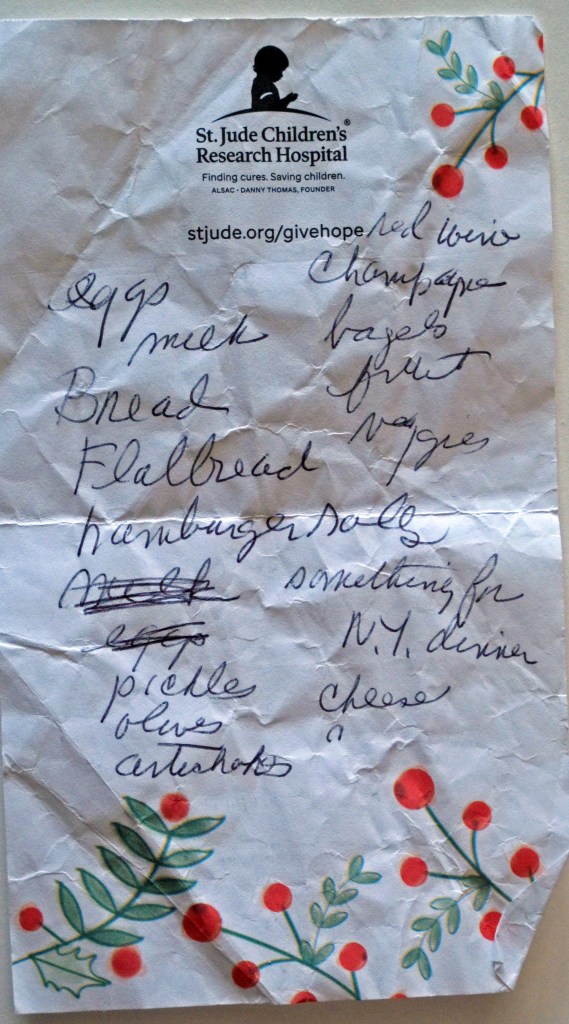
The people represented in this week’s lists are both households of two adults. The one list template was created many, many years ago and has been photocopied and used ever since. One of the participants loves to bake and also makes wine. One of the lists is more of a “stop by the store” rather than a full week of groceries.
To learn about this project, click here. This post is organized this way – the grocery lists, information & facts on food insecurity, resources, and anonymous general information about the people who submitted the lists published. Looking for ways to help out? Check with you local school district or houses of worship to see if they sponsor backpack or grocery bag programs. Check online for organizations such as food pantries, food banks, and soup kitchens that collect food in your area. A list of such organization is being compiled below and will be added to each week.
Helpful Hints when Donating to a Food Program:
*In addition to food, items such as personal grooming products are also needed as well as things like dishwashing detergent. Make sure to donate full size items unless there is a particular reason the organization is looking for “hotel” or “sample” size items. It you are not sure, it is always ok to ask exactly what is needed.
*Food Banks are able to buy in bulk for very good prices so donations of money are always very useful, maybe even more useful than actual food. However, Food Pantries benefit from both actual food items and money. The difference between Food Banks and Food Pantries are as follows: Food Banks feed lots of people from a wide area, either directly or by supplying to soup kitchens and other community food programs. Food Pantries are locally based and address individuals’ needs in the immediate surrounding community. They are often located in churches, or social service agencies as part of larger missions. It is a good idea to check with your local Food Bank/Pantry to see what is most useful to them.
*When donating to backpack programs, choose canned items with pop off or peel off lids in case the recipient does not have or cannot use a can opener.
*When donating macaroni & cheese try to get the kind that is premixed so that no additional ingredients like milk, which may not be available, are needed.
Dialing 2-1-1 will connect a person with information on local services that provide assistance.
Info from this week’s shoppers:
Both shoppers this week are cooking for households of two people. Each shopper is represented by more than one list. One of the shoppers goes to the store often and picks up what they need for that day where as the other shopper is making a weekly trip. Both shoppers live in suburban areas in different parts of the country and supermarkets are conveniently located to each shopper. No particular diets are followed but one of the shoppers stated that the other person in their household tends to eat the same things and often they do not like the same foods.
To learn about this project, click here. This post is organized this way – the grocery lists, information & facts on food insecurity, resources, and anonymous general information about the people who submitted the lists published. Looking for ways to help out? Check with you local school district or houses of worship to see if they sponsor backpack or grocery bag programs. Check online for organizations such as food pantries, food banks, and soup kitchens that collect food in your area. A list of such organization is being compiled below and will be added to each week.
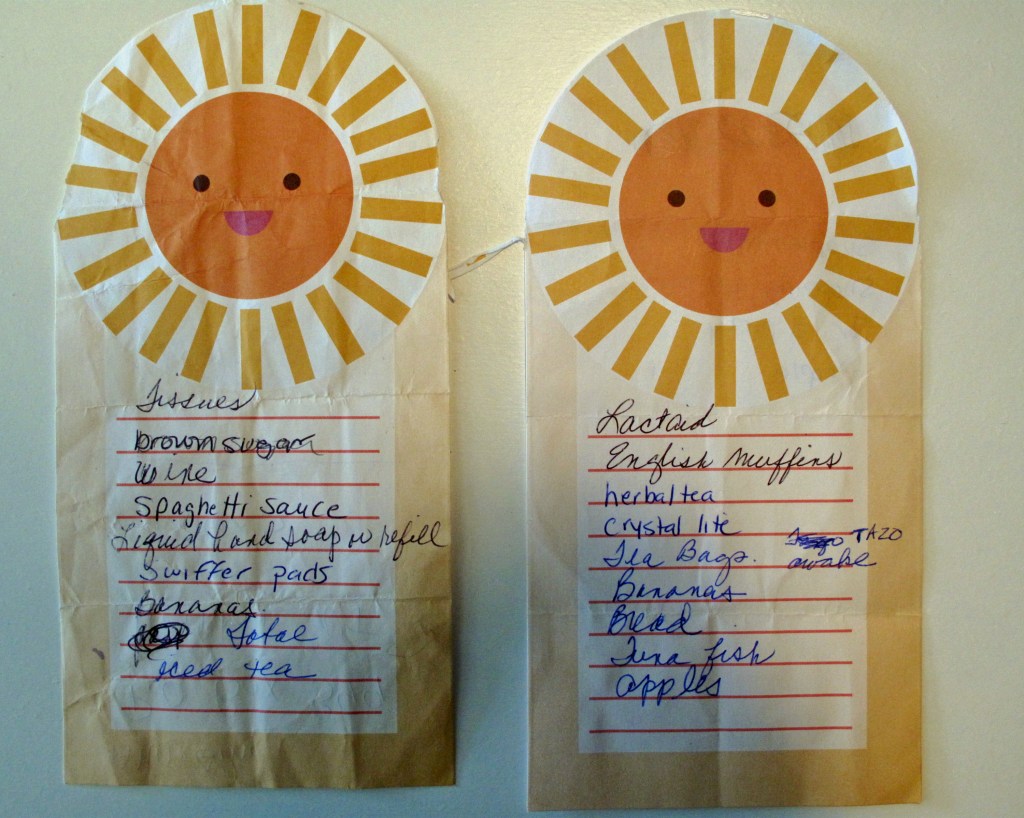
Items on the list above include: tissues, brown sugar, wine, spaghetti sauce, liquid hand soap, swiffer pads, bananas, total, iced tea, lactaid, english muffins, herbal tea, crystal liste, tea bags, bread, tuna fish, applies, Tazo Awake.
Helpful Hints when Donating to a Food Program:
*Food Banks are able to buy in bulk for very good prices so donations of money are always very useful, maybe even more useful than actual food. However, Food Pantries benefit from both actual food items and money. The difference between Food Banks and Food Pantries are as follows: Food Banks feed lots of people from a wide area, either directly or by supplying to soup kitchens and other community food programs. Food Pantries are locally based and address individuals’ needs in the immediate surrounding community. They are often located in churches, or social service agencies as part of larger missions. It is a good idea to check with your local Food Bank/Pantry to see what is most useful to them.
*When donating to backpack programs, choose canned items with pop off or peel off lids in case the recipient does not have or cannot use a can opener.
*When donating macaroni & cheese try to get the kind that is premixed so that no additional ingredients like milk, which may not be available, are needed.
This is an unusual pairing of lists this week. There are four people involved total and they all live alone, however, three of them are currently on vacation together. The description for that bunch is “Three fussy people on vacation”. One of the people used to dine out often for lunch and then save the leftovers for dinner; however, Covid has changed that so now that person cooks home more.
To learn about this project, click here. This post is organized this way – the grocery lists, information & facts on food insecurity, resources, and anonymous general information about the people who submitted the lists published. Looking for ways to help out? Check with you local school district or houses of worship to see if they sponsor backpack or grocery bag programs. Check online for organizations such as food pantries, food banks, and soup kitchens that collect food in your area.
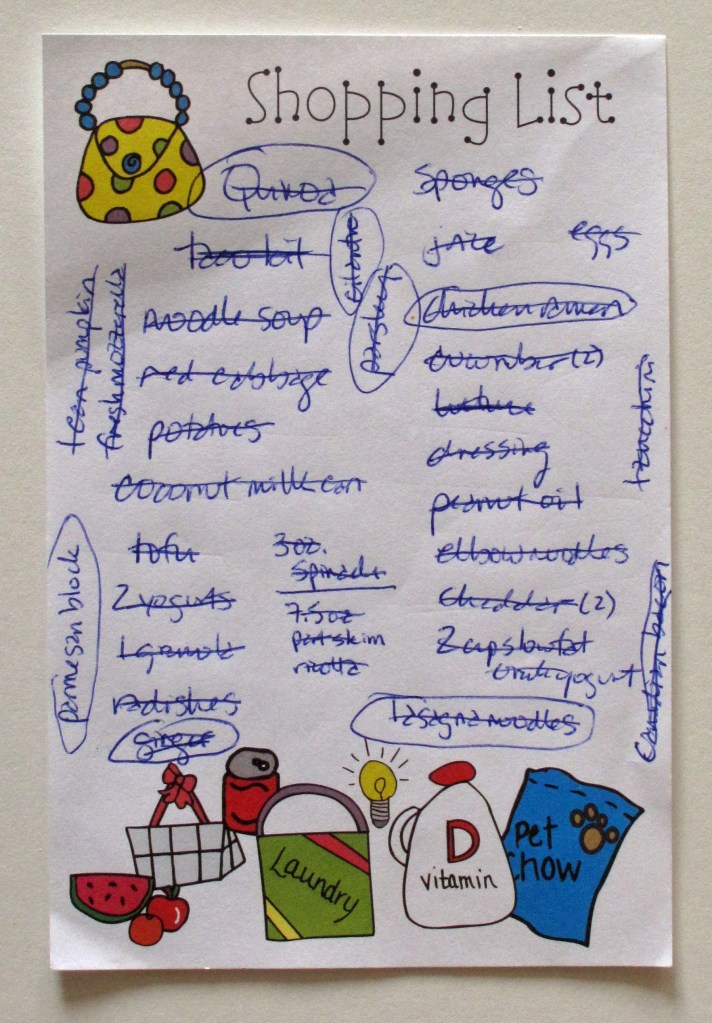
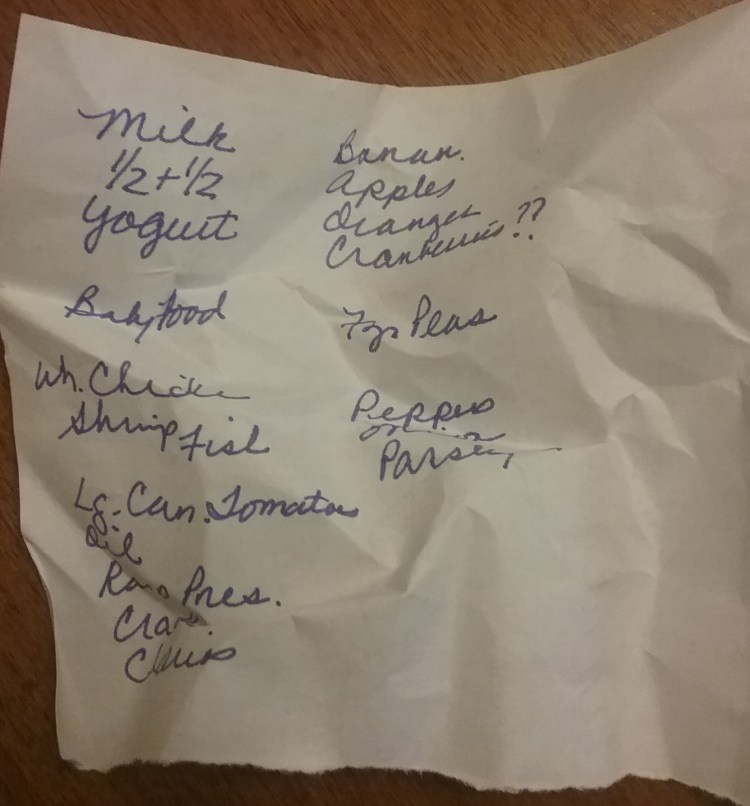
Some items on the list above include: taco kit, red cabbage, coconut milk tofu, canned pumpkin, fresh mozzarella, quinoa, sponges, eggs, ricotta, granola, yogurts, parmesan, elbow noodles, cheddar, greek yogurt, parsley, peanut oil, lasagna noodles, zucchini, soup, ginger, radishes
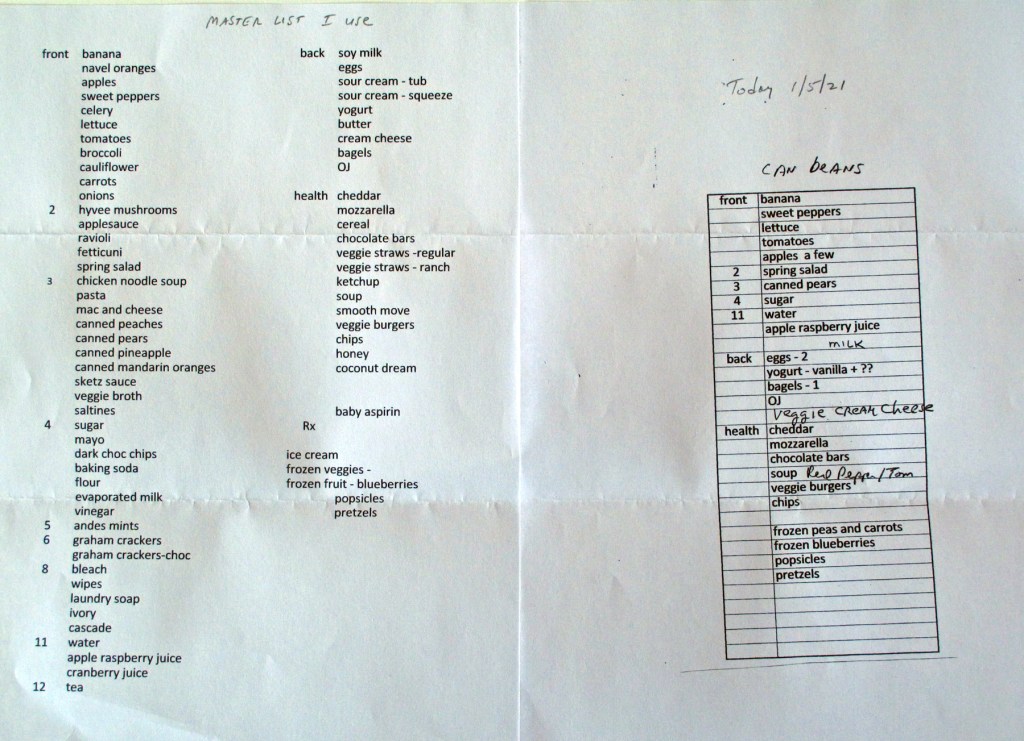
This list is actually a master list (on the left) and the weekly list (on the right). The numbers indicate what aisle the items can be found. This list has been used for many years so the aisle indicators are not related to Covid style shopping.
Helpful Hints when Donating to a Food Program:
*When donating to backpack programs, choose canned items with pop off or peel off lids in case the recipient does not have or cannot use a can opener.
*When donating macaroni & cheese try to get the kind that is premixed so that no additional ingredients like milk, which may not be available, are needed.
Each household is comprised of two adults. One household is mainly vegetarian and the other household tries to include one vegetarian meal a week. One of these participants experienced some food insecurity during college. One of the household’s food preferences is heavily influenced by their travels around the world. One of the households has limited their shopping off and on depending on the level of Covid infection in their area. One household has access to a grocery store but in order to shop at an Aldi’s has to travel approximately 50 miles.
The Grocery List Project is a multi-participant conceptual art project to bring attention to everyday consumption habits of an unspecific group of people as well as bring attention to the problem of food insecurity.
Participants are asked to anonymously share a grocery list to the project. They also have the option to supply other information surrounding circumstances that influence what they shop for. As lists are collected, they will be posted on this blog along with information and resources that address food insecurity. There are a few spots left so if you are interested in participating in the project, please contact me. The project will start to be posted on this blog the end of January, 2021 and run through March, 2021.
Food Insecurity Fact: When donating macaroni & cheese try to get the kind that is premixed so that no additional ingredients like milk, which may not be available, are needed.