This spring I sort of binge watched Mad Men. I had no intention of binge watching it but Netflix was cancelling it as of mid June. Man Men isn’t an easy show to binge watch because it is filled with nuanced behavior and speech. It is also kind of dark but I managed to watch about 1.5 per night.
Since I had seen the series before, I figured I would add a bit of fun to my viewing schedule by giving myself a task. I decided I would count how many “encounters” Don Draper had with women over the course of the entire series which explains the title of this blog post. It was critical to pinpoint the exact indiscretion I was tracking in the title to this post since Don seemed to engage in so many.
Season 1:
Don is married to Betty Draper
Midge, the graphic artist
Rachael Menken, the department store owner
Season 2:
Don is married to Betty Draper
Bobbie Barrett, manager and wife of a well known comedian
Joy, a young girl in California living a jet set version of a vagabond life
Season 3:
Don is married to Betty Draper
Shelly, an airline stewardess (that was the job title then). You only saw her once but you got the idea they squeezed each other in during layovers
Suzanne Farrell, Don’s daughter’s teacher.
Season 4:
Don is now divorced from is wife, Betty, so he makes up for any lost opportunities
A prostitute he sees regularly, name not mentioned
Allison, his secretary
A woman from an ad agency, a one night thing
Doris, another one night thing
Bethany, a friend of Jane who is Roger’s wife
Dr. Faye Miller, a psychological consultant under contract with Don’s firm
Meagan Calvet, his secretary
Season 5:
Don is now married to Meagan, his former secretary. He actually behaves himself for this whole season.
Season 6:
Don is married to Megan.
Sylvia Rosen, his neighbor downstairs
Betty (Draper) Francis, his former wife
Season 7:
Don is now separated and eventually divorced from Meagan
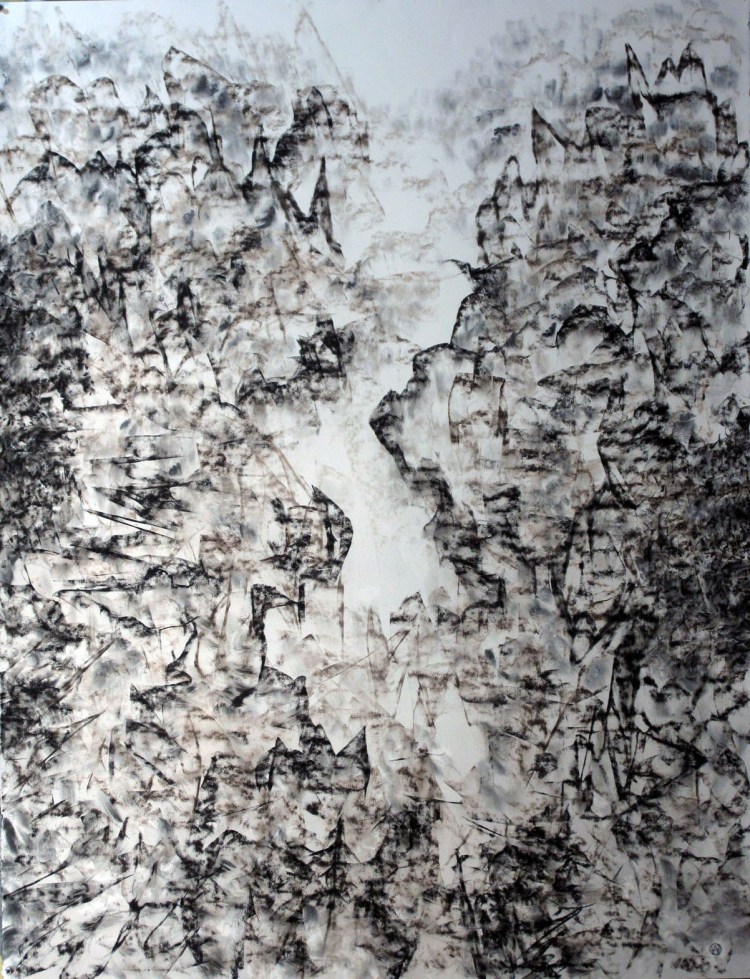
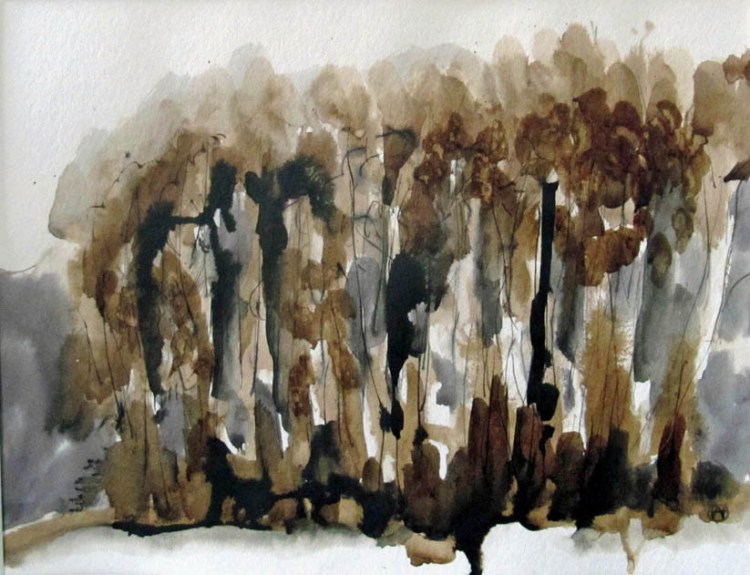
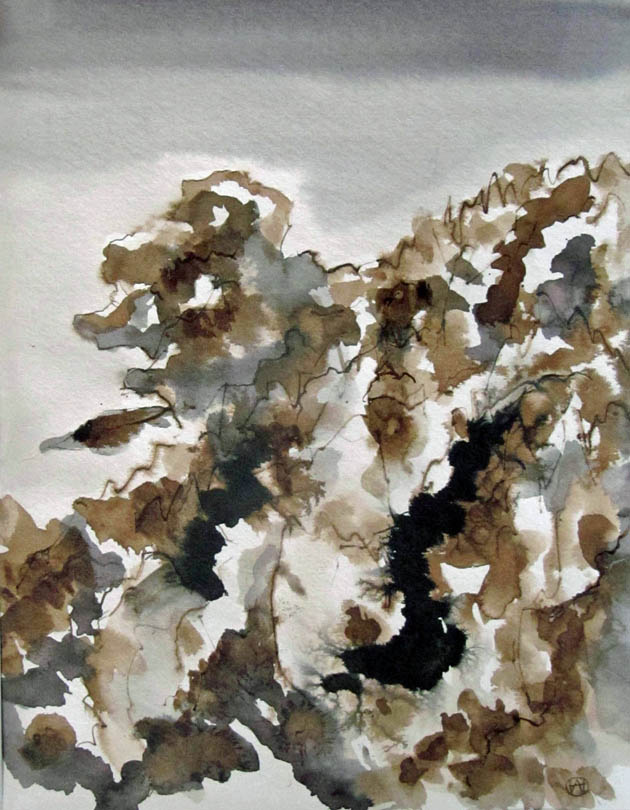
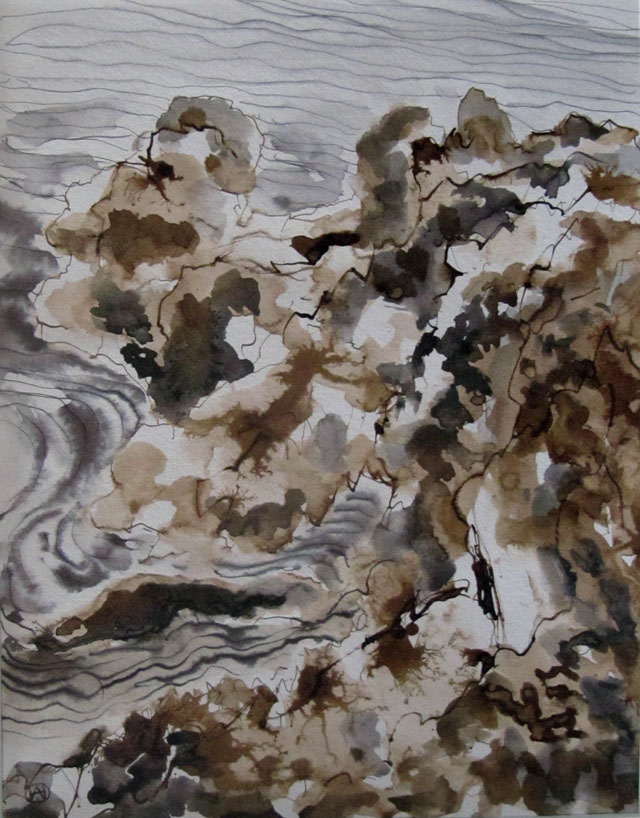
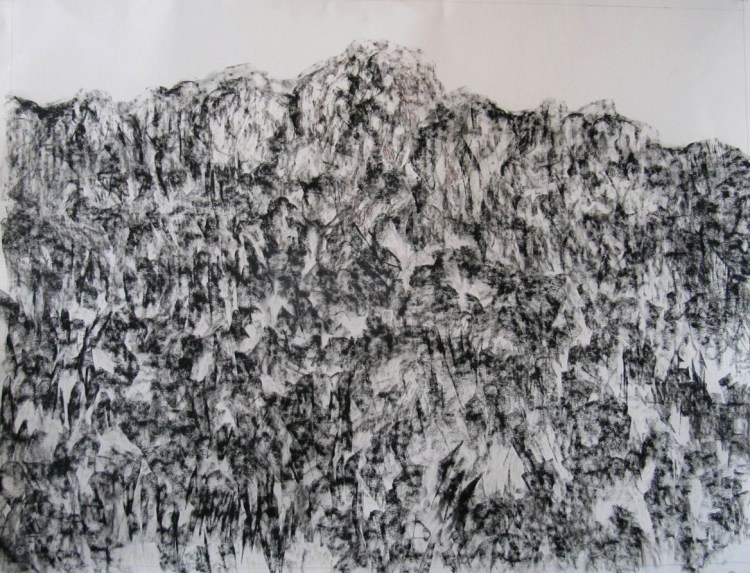
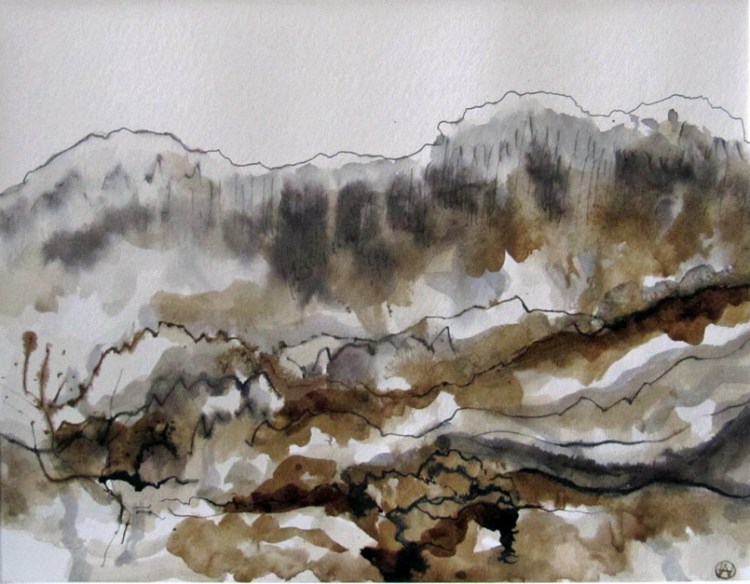
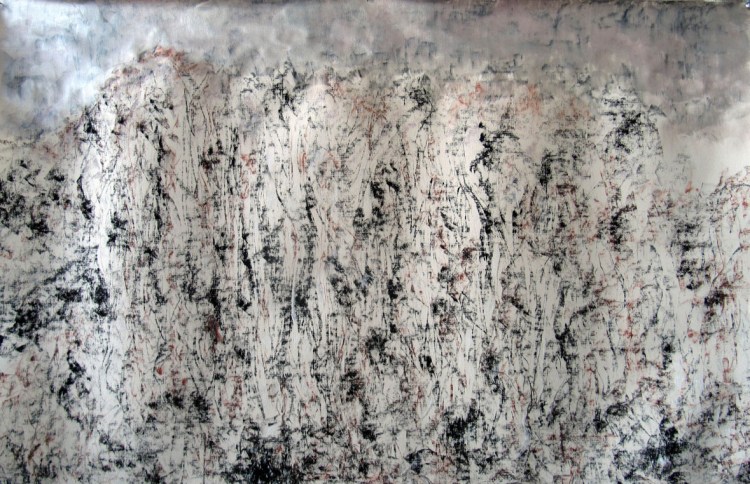
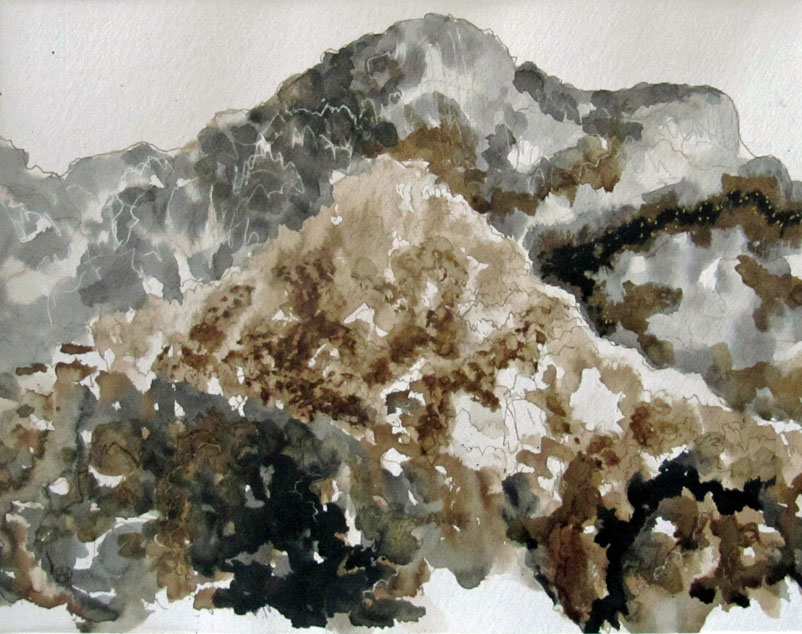
These drawings by Anders Hansen are from a trip he took to Spain in the fall of 2019. Note: if the images are reading too small on your device you may want to right click on them to enlarge.
My tenth birthday fell on Passover. I was raised as an Italian Catholic but a friend of mine was Jewish and her family invited me to their Seder that year. I was not sure what that was but my father, who was very big on experiencing other cultures, insisted I attend. So I did. Though it was a traditional Seder as far as the prayers and the main meal, at the end they bought out a birthday cake for me. I did not understand until much later why my parents found that to be so amusing.
Because I grew up in a large city, there were always enclaves of different racial and ethic groups close by and in attendance at my school . Oddly, it was when we moved to a suburban area that I experienced the most diversity as far as close neighbors. The majority of the families living on our block were either African American, Jewish, or Italian.
So I knew first hand that being among others unlike me racially or ethnically enabled me to see things from other points of view and helped me to be very accepting of others. It was not until much later that I also began to think of diversity in terms of geographic culture or in relation to sex, sexual orientation, and gender identity.
Enter my friend Claudia who is from Tennessee. I met Claudia doing art fairs and at that time she had been a resident of the North for many years. Not all that long ago in the grand scheme of all the years I have known Claudia, I asked her how she landed North. College was what bought Claudia North and among the many reasons she was accepted at her college was “diversity”. I never thought of someone from the South as “diverse” in the sense of my definition of the word. But then I moved to the South.
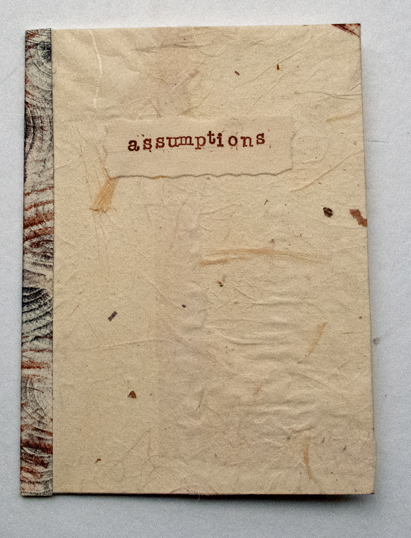
Assumptions, artist book addressing geographic food preferences
Here, I have met many wonderful Southern people. And yes, they are different from me in many ways and it has enriched my life tremendously. Ok how are they different? Here are just a few: food, general mannerisms, figures of speech, humor, influence of faith, etc. Not long ago, my friend Alice revealed to me that she is originally from the town where My Cousin Vinny was filmed. I was overjoyed because I absolutely LOVE that movie as it reminds me of several of my relatives. We decided that at some point, we will have a Vinny party and observe and explain the various cultural nuances of the movie to one another.
On a very different level but still related very much to point of view, last night I watched an interview with Melinda Gates. I am paraphrasing this story but basically she was explaining that it was very difficult for some groups of people and women to get business funding from venture capitalists and gave a very interesting example involving an African American woman who wanted to start a hair braiding business. Because the VC’s were men who had little interest in hair, they asked their wives if they thought it was a good investment. Because the wives were not African American and did not understand the culture of hair in the African American community, they said they did not think it was a good idea. I believe the woman eventually got funding and was wildly successful, however, it shows how unawareness and an unwillingness to learn of a facet of someone’s culture can be a detriment to everyone involved.
The Other, Mixed Media, Collection Free Library of Philadelphia Print & Picture Collection
In the past few years, my life has been enriched even more because people of different racial and ethic origins are now related to me by blood. This has had a profound effect on my thinking because now my world has been expanded to consider issues concerning places around the entire globe.
My title to this post is How to Enrich your Life. While it may not be easy to learn about someone different from you by traveling , moving, or acquiring new relatives there are so many other ways a person can. There are books, documentaries, organizations with an internet presence, different houses of worship, and meetings in your community that would welcome visitors. So I guess what I am trying to get at here is that the more we reach out to people who are not like us, the richer our lives will be and hopefully we will be better people for the effort.
Note: you can read more about the piece pictured above titled The Other by clicking here.
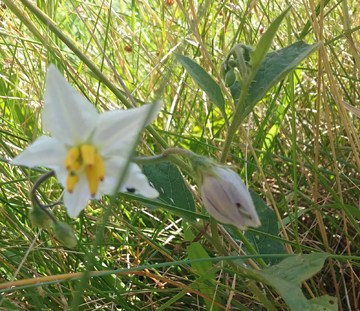
When I used to walk around my old neighborhood looking for sidewalk weeds, one that I came upon often was Carolina Horse Nettle (Solanum carolinense) and Eastern Black Nightshade (Solanum ptycanthum). These plants, though pretty, are considered nasty weeds by many gardeners and home owners. Adding aid to that general consensus are the facts that they are also prickly to touch and poisonous. Anyway, I always thought they were very pretty flowers and spent a great deal of time studying the flower’s star shape and how the color of the stamens and pistils contrasted nicely with the petals and how they protruded added more interest to the overall flower shape.
Fast forward a few years and I found myself working as a farm hand in North Carolina helping to farm, mainly, tomatoes. When you tend to approximately 2,000 tomato plants you kind of get familiar with them. One day I noticed that the flowers of the tomato plants had a very familiar look.
Tomato plant
I saw the same star shape as the nightshades plants mentioned above and the same type of protrusion of the stamens and pistils. Because there were several waste fields around where I farmed, it was not difficult to pluck and few flowers from each plant and compare them up close to one another. When I went home, I looked in my field guides and learned that Tomatoes are also in the genus Solanum. As the summer went on and I watched some of the other crops flower and fruit, I saw a few other versions of this same flower on plants like potatoes and bell peppers. My point is this: observation is a far better tool than calling something up on a smart phone, which you will probably forget two seconds later. This is why drawing is also a valuable exercise to really learn what something looks like. So put away your smart phone. Use your eyes, nose, and ears and maybe even a pencil and pad of paper to learn about nature in a truly meaningful and unforgettable way.
Below are the photos above with a few others views so you can see a side by side comparison.
Swarthmore College Library is presenting Hyper Local: New Works in the Swarthmore College Libraries Collection. I am honored to be part of this collection and exhibition. Because of the current health situation, this exhibition is available online. Click here to view the 24 books included.
Today I was walking around the campus of Davidson College and came upon the large scale stick installation I participated in creating over the winter. As I walked through the sculpture I thought: Gee how much has changed in the world since those few months ago. No sooner did that thought cross my mind did this other thought follow: No it hasn’t. And then I thought again: Yes it has. Ok, enough of the merry-go-round. I will explain.
Highly contagious disease is nothing new to a good part of the world, nor are Pandemics. It is our good fortune that we have really not had to deal much with them. So it is not new, it is only new to us. Racial injustice is also nothing new, many of us have just been blind to it.
So what is new then?
Lately, I have taken a great interest in Buddhism. One of the principles of Buddhism is that suffering is part of life. This sounds like a really depressing concept until you dig deeper and understand that suffering also leads to compassion. And more compassion, in the long run, leads to less suffering.
One of my favorite definitions of compassion is from theologian Marcus Borg who equates (and I am paraphrasing) compassion with a deep, gut level connection with others. This is the kind of feeling that once experienced, is hard to ignore.
It is easy to become complacent again once we are all healthy, back to work, and the news is only telling us things we don’t mind hearing. But once we feel compassion, it is hard to look away and feel ok about it. Feeling compassion is to be truly human. It is a good feeling. So maybe that is what is new.
Many large companies are making public statement condemning racism. My hope is that these companies who are large retailers will start with their own company culture and tell their employees to stop targeting black and brown people by following them around their stores. Just saying.
Linoleum and woodblock printing are forms of Relief printmaking, which mean that the image is printed from a raised surface. This is very different from other forms of printmaking such as Intaglio (etching, engraving, drypoint), Serigraphs and Lithographs.
Plain piece of linoleum made specifically for relief printing
Relief printmaking is the oldest form of printmaking, whether it be making a rubbing from a gravestone (also known as frottage), or from a cut block of wood. Linoleum is a material that became popular for relief prints in the 20th century. Linoleum was invented in the mid to later 1800s as a product for floor covering. Now, there is linoleum specifically made for the purpose of relief printing and is free from the flaws that commercial linoleum had. I have mainly used linoleum but I am starting to develop a liking for wood.
So what exactly does it mean to print an image from a raised surface. Above you can see a plain piece of linoleum, nothing has been drawn or cut out yet. Below you see a piece of linoleum that has been cut. What has been removed is the part of the block that will not pick up ink that is being rolled on top. Assuming that the paper the block is being printed on is white, that is the color that those cut away parts will be in the final print.
A piece of linoleum that has been carved. The parts that have been carved away will not pick up any ink
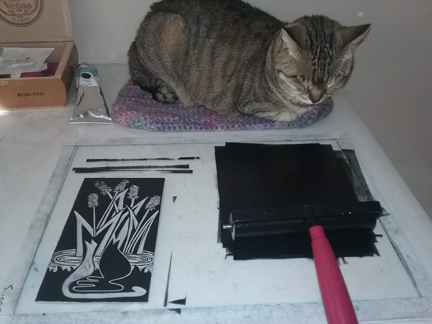
Below you can see the block after ink has been rolled on top using a tool called a Brayer. Relief ink is thick but also creamy, sort of like the consistency of butter that has been left out of the refrigerator for a bit. The ink is rolled out on a glass slab and then rolled onto the linoleum block. It is very easy now to see what has been carved away. Lulu, my cat, was supervising this particular application of ink but appears to have fallen asleep.
A piece of carved linoleum with ink applied
And here is what the print looks like after the ink has been transferred onto paper. I use a printing press but it is possible to transfer the ink to paper but hand rubbing with a tool called a Baren, or even a large spoon. I prefer a press because it prints the image evenly.
Finished artwork after it was printed
The writing on the margin of the print is the title (center), my signature (right) and information about the print on the left. In this case, this print is an “open” edition, meaning that it can be printed a number of times until the block disintegrates. Generally, if a piece of linoleum is stored correctly, the image can be printed approximately 50 times Some artist like to number their prints. I do not unless it is truly limited due to the method of making the artwork (this is called a reduction block and I will talk about this in the future). Relief prints are all original works of art because the block is inked up and printed each time the image is transferred. It is almost impossible to make them exactly alike although with enough practice inking and printing you can get pretty close. Still, each one is an original. I mark my open edition prints like this: 1/Imp That means it is one unique impression. The idea of numbering prints at all came to be in the 20th century. Rembrandt, Durer and other artists did not number their prints. You can see more of my bock prints by clicking here.
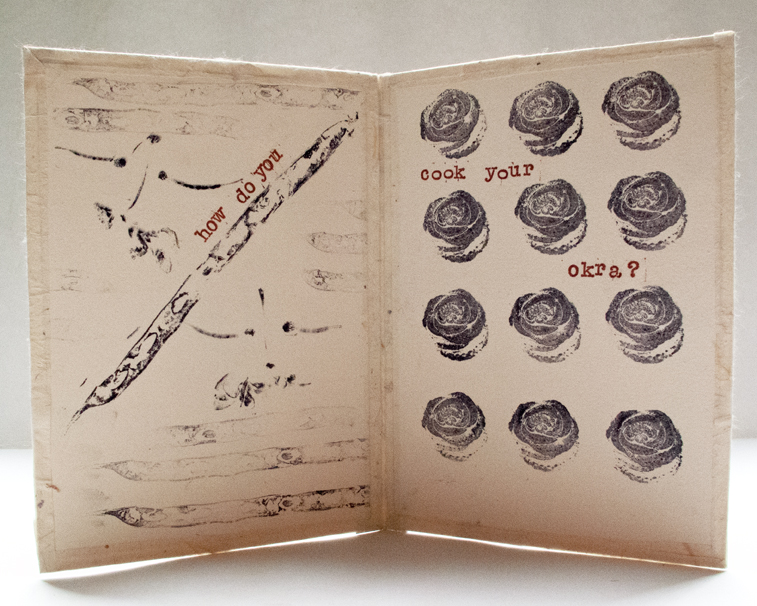
Assumptions, 2020, Artist book, Ink & paper 7.5″ x 10.5″ open
Since I have mainly lived in the same geographic area for most of my life, the cultural encounters I had with food tended to be more influenced by late 19th and early 20th century European immigrants from many countries.
Upon moving to the South, I realized that since the population was historically different, many of the foods I grew up with were not widely available. An example of this is a recent conversation I had with a local life long resident who told me she had never heard of a zucchini until she went to college. Oddly, it was something her father said to me a few years ago that prompted the artist book featured in this post.
The book is titled Assumptions, and it is about what we presume to be the foods that are part of other people’s lives. If you ever saw My Cousin Vinny, you are well aware of the scene in the restaurant where the main characters are confronted with grits for the first time. The question that my local friend posed to me one day was “How do you cook your okra?”. “Huh??” was my response. It was only shortly before I moved that I ever even saw okra at my local vegetable stand up North. My understanding of it was an ingredient you put in gumbo and that was pretty much it.
I have since become quite acquainted with okra, not only as a vegetable prepared different ways but also as a plant because I spent three summers harvesting lots of okra. I can add onto my knowledge of okra these facts and observations: that by the time you get to the end of the row picking it, more has grown at the beginning of the row. You could probably spend several hours a day picking and repicking the same row of okra (assuming you have lots of plants). You should always wear long sleeves when picking okra and gloves or your skin will be very irritated. Okra is part of the hibiscus family so even it you don’t like the fruit, it is a lovely and vigorous plant.
It is no accident that Okra is not included in the graphics of this book as it was something quite absent from my former life. For the curious I will tell you that the vegetables pictured are green beans and the diminished base of a bunch of celery (two vegetables that seem to be part of many cultures) And for the record, zucchini is now plentiful where I currently live. How do you cook your Okra??
 This spring I sort of binge watched Mad Men. I had no intention of binge watching it but Netflix was cancelling it as of mid June. Man Men isn’t an easy show to binge watch because it is filled with nuanced behavior and speech. It is also kind of dark but I managed to watch about 1.5 per night.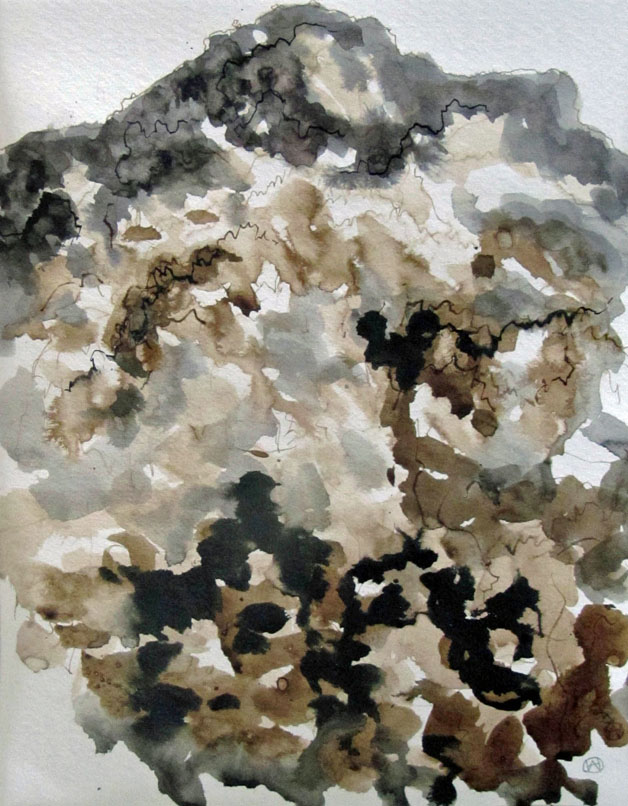
















 anniepodart.com